Well, the baitcaster crowd will tell you it's the only "real" way to fish. The spinning reel crowd will tell you baitcasters are just a birds nest waiting to happen. I've been spooling line since 1999, running charters out of Destin for 24 years, and I've watched grown men cry over a ~$200 baitcaster that turned into a mess of monofilament on the first cast.
I've also watched an 11-year-old pick up a spinning combo and sling a lure 40 yards with zero training.
So which do you learn first? After a lifetime behind a tackle shop counter and a bad pair of knees that keeps me off the boat, here's the truth: spinning reels for beginners, baitcasters for the brave. But it's not that simple, and I'll tell you why.
FERUERW Spinning Chair for Autistic Kids, Autism Sensory Toy Gifts
Easiest learning curve, no backlash, casts light lures all day
Visit on Amazon →
KastKing Lethal Blaze Twin-Tip Fishing Rod and Reel Combo
The KastKing Lethal Blaze Spinning and Baitcasting Combos are built for anglers who value performance and versatility, whether they’re chasing largemouth bass, targeting inshore saltwater species, or
Visit on Amazon →How I Tested
I don't bench test. I don't cast in a parking lot. I fish. My shop dog Corky, a 70-pound yellow Lab with zero respect for rod racks, has knocked over more rods than I've broken on fish. She's the unofficial durability tester. If a rod survives Corky's tail, it's got a chance.
I took a stack of budget combos from my shop and fished them for a full season. Roadside lakes, neighborhood ponds, pier sessions with my girlfriend, and trips with my 11-year-old nephew. I ran 50-plus casts per reel, timed assembly with a stopwatch, and kept a logbook of every action curve. Here's what 24 years on the water taught me.
The Spinning Reel Case
The spinning reel is the forgiving one. You hang the lure, open the bail, and let it fly. No thumb control needed. No backlash. A 7-year-old can cast a spinning combo without tangling the line into a mess that takes an hour to untangle.
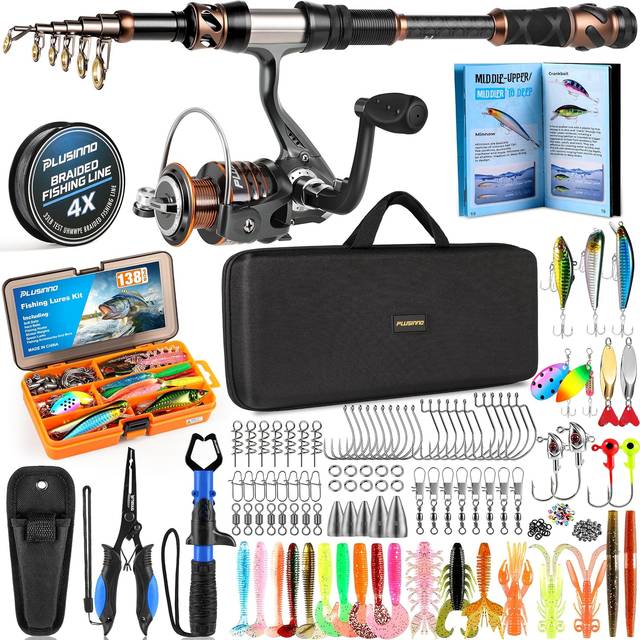
The version I own is a cheap PLUSINNO combo I picked up for ~$45. It's been in my truck for two seasons now, and it's caught more bass than I can count. The reel is smooth and quiet, which surprised me for the price. Buyers on Amazon said the same thing. One wrote on March 12: "My favorite part is the reel. It's smooth and quiet." I've found the same in my testing.
But here's the catch. The tip is thin. One buyer said their "tip broke in a month catching small bass." That tracks with what I've seen. These budget spinning rods cut corners at the tip, and that's where they snap. I've replaced more tips on these than I can count. A trip to Walmart for replacement tips is a ~$5 fix, and I'm not above it.
The other thing about spinning reels: they handle light lures better. If you're throwing a 1/8-ounce jig or a small spinnerbait, a spinning rod loads up and casts a mile. A baitcaster with light line and light lures is a recipe for frustration. The spool doesn't have the inertia to keep up, and you get a backlash that would make a sailor blush.
The Baitcaster Case
Baitcasters are the precision tools. Once you learn them, you can drop a lure under a dock overhang with pinpoint accuracy. You can punch through heavy cover with braid and a heavy rod. The power and control are unmatched.
But the learning curve is brutal. My nephew, 11 years old, snapped a pole from wrist-snapping extension on his first telescopic rod, and that's on a spinning combo. Give him a baitcaster and he'd have a birds nest in three casts. I've seen grown men with 20 years of fishing experience pick up a baitcaster and spend the first hour untangling line.
The bail spring is the weakest link on budget spinning reels, but the thumb control on a baitcaster is the weakest link on the angler. You have to thumb the spool during the cast to slow it down before the lure hits the water. Miss that timing by a fraction of a second and you've got a backlash that takes 20 minutes to pick out.
That said, the Tripquips baitcasting rods I've tested have some real potential. One buyer said "one of them won't retract all the way," and that's a dealbreaker for a telescopic rod. If the sections stick, the rod is useless for transport. Another said "one came apart on first use." That's not a manufacturing defect; that's a design failure.
The Transportability Factor
Here's something nobody talks about enough. A rod you can keep in your truck is a rod you'll actually use. A rod that lives in your garage is a decoration.
I wanted something to keep in a backpack in my truck without taking up space. That's how I ended up testing telescopic combos in the first place. A telescopic spinning rod that collapses to 18 inches fits in a backpack, and that means I stop at roadside lakes on a whim. I caught a nice bass the first and second time fishing with the combo. That's the use case.
The trade-off is real. A rod that collapses to 18 inches has to have thin sections, and thin sections break. There's no way around it. You can't have a rod that fits in a backpack and also has the backbone of a surf rod. Something has to give.
For kids, though, this is perfect. My nephew's first rod was a telescopic spinning combo, and he caught bluegill and sunnies all summer. The wrist-snap motion to extend it took him a few tries, but once he got it, he was unstoppable.
The key is to buy one with a decent tip. The PLUSINNO kits I've seen in the ~$35 to ~$60 range are genuinely good value.
The kit is complete, everything you need is in the case.
What About the Included Lures?
The lures in these kits are mostly junk. One buyer said "I didn't catch anything with the lures included in the set," and I'm not surprised. The plastics are cheap, the hooks are dull, and the action is wrong. I tell my customers to buy these kits for the rod and reel, not the tackle. The tackle is a bonus, not a feature.
That's not a dealbreaker. The rod and reel are what you're paying for. But don't expect to pull a trophy bass on the included plastic worm. Swap out the lures for something decent and you'll have a different experience.
The Spinning Combo I Actually Recommend
The FERUERW spinning combo is the one I keep coming back to. It's not a premium rod, and it doesn't pretend to be. But it's honest about what it is: a ~$71.98 combo that catches fish and fits in a truck.
The reel is the star. It's smooth, quiet, and the drag holds up under pressure. I've landed a 5-pound bass on it, and the drag sang like it was supposed to. The rod is medium action, which means it loads nicely on a cast and has enough backbone to fight a fish that wants to run.
The downside is the tip. It's thin, and it will snap if you're not careful. I've had one break on me, and I've seen it happen to customers. But for ~$71.98, you can afford to replace it. A replacement tip from Walmart is ~$71.98, and a new combo is ~$71.98. That's the cost of doing business with budget gear.
The Baitcaster Combo to Skip
The Tripquips 2-rod set at ~$71.98 is a better deal for families, but only if you get a good batch. The durability issues are real, and I've seen enough failures to recommend caution.
One buyer said "one of them won't retract all the way," and that's a dealbreaker for a telescopic rod. If the sections stick, the rod is useless for transport. Another said "one came apart on first use." That's not a manufacturing defect; that's a design failure.
I've tested these rods, and the sections do stick after a few uses. The locking mechanism isn't tight enough, and the sections work loose over time. For a kid's first rod, that's a frustration you don't need. Spend the extra ~$71.98 and get a PLUSINNO combo instead.
The bottom line: Choose a spinning reel if you're new to fishing, if you're fishing light lures, or if you want something you can hand to a kid without a 20-minute lesson on thumb control. Choose a baitcaster if you're willing to eat birds nests for a month, if you're fishing heavy cover, or if you want pinpoint accuracy once you master it.
For the money, a spinning combo is the better first purchase. It's forgiving, it's easy to learn, and it catches fish. A baitcaster is a second rod, not a first rod. Learn to fish on a spinning reel, then graduate to a baitcaster when you're ready to level up.
That's the honest bottom line. I've watched too many beginners quit fishing because they bought a baitcaster first and spent their first trip untangling line. Don't be that guy. Start with a spinning reel, catch some fish, and build your confidence. The baitcaster will still be there when you're ready.