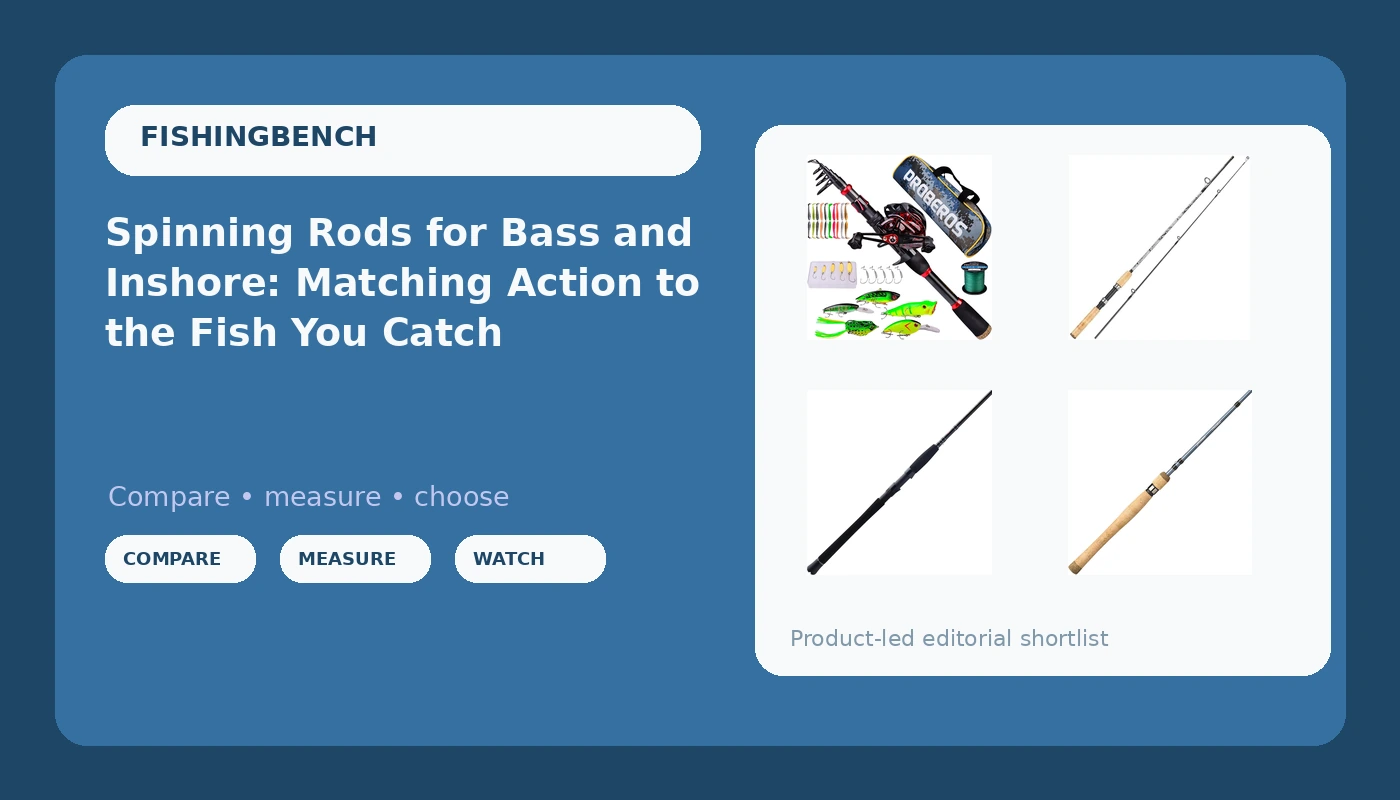
Walk into a tackle shop and you will see the same thing on every rack: a wall of spinning rods, each one described as sensitive, powerful, and ready for anything. Almost none of them tell you what they were actually built to do. If you fish largemouth in a farm pond one weekend and redfish in the bay the next, you already know one rod rarely does both jobs well, and the hang tag is not going to explain why. This is an explainer on spinning rods for bass and inshore fishing, built around the three parts that decide whether a rod is still fishing with you in year three: the action of the blank, the guides that route your line, and the reel seat that holds everything together. Four current listings sit at different points on that map, from a packable telescopic combo to a rod named specifically for inshore salt.
Related: Rod Action vs. Rod Power: What the Labels Actually Mean →
Quick answer
The short answer is that you match the rod to the fish you actually catch, not to the fish on the catalog cover. For mixed freshwater work across bass, trout, panfish, and catfish, a composite blank with stainless steel line guides covers a wide range of lures, which is roughly where the Sougayilang composite rod sits. For saltwater inshore fishing in bays, on flats, and around jetties, a rod designed for that environment, like the PENN Squadron IV Inshore, is the more sensible starting point because the hardware has to tolerate salt. For general freshwater spinning, the Pflueger President spinning rod is a rod-only option that lets you pick your own reel. For travel, ice, and one-bag setups, the telescopic carbon fiber combo packs a rod and reel into a small space. None of these is universally the right answer, and no listing here can be called the best without knowing your water, your lures, and your budget.
Four useful options
| Model | Best fit | What stands out |
|---|---|---|
| Fishing Rod and Reel Combo, 6.9ft Carbon Fiber Telescopic Fishing Pole with Spinning/Baitcasting Reel Combos, Sea Saltwater Freshwater Ice Bass Fishing Tackle Set Fishing Rods Kit | Travel, ice, and packable setups | Telescopic carbon fiber blank at 6.9 feet, sold as a rod and reel combo |
| Sougayilang Spinning & Casting Rods, Strong Carbon&Glass Composite Fishing Rod with Stainless Steel Line Guides for Bass, Trout, Panfish, Catfish | Mixed freshwater species | Carbon and glass composite blank with stainless steel line guides |
| PENN Squadron IV Inshore Spinning Rod | Saltwater inshore work | Inshore spinning rod from a brand with a deep saltwater catalog |
| Pflueger President Spinning Rod | General freshwater spinning | Rod-only listing carrying a familiar spinning tackle name |
Starter kit: Fishing Rod and Reel Combo, 6.9ft Carbon Fiber Telescopic Fishing Pole with Spinning/Baitcasting Reel Combos, Sea Saltwater Freshwater Ice Bass Fishing Tackle Set Fishing Rods Kit
The trade-off with any telescopic rod is joints. Every extra section is a place where the blank changes stiffness and where feel gets slightly muffled, because the rod is no longer one continuous piece of material. That matters most when you are dragging a soft plastic across the bottom and need to know whether it is mud or shell. What you get in return is a rod that fits in a backpack or a carry-on, plus a reel already matched to the butt. For an angler who fishes a handful of times a year, keeps a rod in the truck, or wants something for a pond, a pier, and a frozen lake in the same season, that convenience is the whole point. Check the joint fit when it arrives, and keep the ferrules clean.
Composite all-rounder: Sougayilang Spinning & Casting Rods, Strong Carbon&Glass Composite Fishing Rod with Stainless Steel Line Guides for Bass, Trout, Panfish, Catfish
A carbon and glass composite is a deliberate compromise, and it is usually a smart one at this price point. Carbon gives the blank light weight and a quicker recovery, while fiberglass adds toughness and a softer, more forgiving load. That blend tends to be more tolerant of the mistakes beginners make, like high-sticking a fish at the boat or setting the hook with the rod pointed straight up. Stainless steel line guides are the other detail worth noting, since guide material is where budget rods usually cut corners and where monofilament and braid do their damage over a season. Run a cotton swab around the inside of each guide after a few trips, and if it snags, that guide is already costing you line.
Inshore saltwater: PENN Squadron IV Inshore Spinning Rod
Inshore is not a marketing word, it is a description of the environment. Bays, grass flats, jetty rocks, dock pilings, and the mouths of tidal creeks all put a rod in salt air and salt spray, and salt is what kills cheap hardware. Guides corrode, reel seats seize, and finish chips turn into corrosion points. A rod that carries an inshore designation is built with that exposure in mind, which is why saltwater anglers tend to shop by brand reputation in this category. Buying the rod by itself means you decide where the balance point lands, and balance is what lets you cast for four hours without your wrist quitting. Match the rod to the weight of the lures and jigs you actually throw, then pick a reel that sits in the middle of the rod's listed range.
Freshwater all-rounder: Pflueger President Spinning Rod
This is the middle of the market, and the middle of the market is where most anglers should be shopping. A dedicated freshwater spinning rod in this range usually gives you a cleaner blank than a combo kit, because the money went into the rod instead of a bundled reel. That matters if you already own a spinning reel you trust, or if you would rather put your budget into the reel and the line. The other advantage of buying rod and reel separately is that you can replace one without replacing both, which is how a setup survives ten seasons instead of two. If you fish ponds, reservoirs, and rivers for bass, panfish, and the occasional catfish, this is the shape of the decision.
Prices and availability may change. Product images, names, and retailer links are matched to verified listings. No current price, rating, stock status, or measured result is stated here without current evidence.
How rod action actually works
Action describes where a blank bends under load, and it is the single spec that changes how a rod feels in your hand. A fast action rod bends mostly in the top third, which means it loads quickly on the cast and snaps back hard on the hookset. That is useful for single-hook presentations, jigs, and soft plastics, where you need to drive a hook through a plastic body and into a jaw. A moderate action bends further down into the middle of the blank. It loads more gradually, which makes it forgiving on treble-hook baits like crankbaits, because the rod absorbs some of the head shake that would otherwise pull hooks free. A slow action bends deep into the butt, and outside of specialized applications it mostly shows up on inexpensive glass rods.
Power is a separate number, and it is where the marketing gets loud. Power describes how much force it takes to bend the rod, not where it bends. You can have a fast, medium-power rod and a moderate, medium-heavy rod, and they will behave nothing alike. When a listing says a rod is strong, that is a claim about durability, not about action, and it tells you nothing about whether the rod will load the lure you plan to throw. Read the action first, then the power, then the lure weight range.
Guides, reel seats, and the parts that fail first
Blanks rarely break. Hardware fails. The guides are the part of the rod your line actually touches, and every cast drags line across them at speed. Cheap guides groove, and a grooved guide turns braid into sandpaper, shredding line and costing you fish at the worst moment. Guide material and guide inserts are the two things to check on any budget rod, and stainless steel line guides are a reasonable baseline for a rod that will see mixed fresh and salt water. After every saltwater trip, rinse the rod with fresh water and dry it before it goes in the rack.
The reel seat is the other failure point, and it is the one anglers ignore until it costs them. A reel seat that flexes or works loose under load lets the reel twist in the seat, which changes your line angle mid-fight. Test it before you fish: mount the reel, tighten the seat, then try to rock the reel side to side with your hand. If there is movement you can see, there will be more under a fish. The handle matters too, since cork, EVA foam, and composite grips all behave differently when they are wet, and a slick grip on a rainy day is a real problem.
- Name the fish you catch most often in a normal month, not the fish you hope to catch once a year.
- Decide whether the rod will see salt water, because that answer sets your minimum hardware standard.
- Pick an action that matches your dominant technique: fast for jigs and plastics, moderate for treble-hook baits.
- Check the parts that fail, meaning the guides, the reel seat, and the grip material.
- Decide whether you want a combo or a rod only, and budget for line and terminal tackle either way.
Practical guidance
- Rinse any rod that touched salt water, then dry it before storage, because corrosion starts in the guides.
- Run a cotton swab inside each guide after a few trips to catch grooving before it shreds line.
- Check reel seat tightness before every trip, and re-check it after a fish that pulled drag.
- Store telescopic rods collapsed and dry, and never force a stuck section, because twisting can crack the ferrule.
- Buy for the fishing you do ninety percent of the time, and rent or borrow for the trip you take once.
Which option should you choose?
Choose the Fishing Rod and Reel Combo, 6.9ft Carbon Fiber Telescopic Fishing Pole with Spinning/Baitcasting Reel Combos, Sea Saltwater Freshwater Ice Bass Fishing Tackle Set Fishing Rods Kit when you want one packable purchase that covers travel, ice, and casual trips without shopping for a reel separately. Choose the Sougayilang Spinning & Casting Rods, Strong Carbon&Glass Composite Fishing Rod with Stainless Steel Line Guides for Bass, Trout, Panfish, Catfish when your water is fresh and your species list runs from trout to catfish. Choose the PENN Squadron IV Inshore Spinning Rod when you fish bays, flats, and jetties and need hardware that tolerates salt. Choose the Pflueger President Spinning Rod when you already own a spinning reel you like and want a dedicated freshwater rod in the middle of the market.
One caveat applies to all four. This article describes what each listing is built and marketed for, not a measured performance result, and no rod here should be called the best without knowing your water, your target species, and your casting style. Confirm the length, power, action, and line rating on the current product page before you buy, because listings change.
The bottom line
A spinning rod is a system of blank, guides, and reel seat, and the one that serves you best is the one matched to the fishing you actually do. Composite freshwater rods cover the widest species range, inshore-designated rods handle salt, rod-only listings let you build a setup around a reel you already trust, and a telescopic combo solves the packing problem. Get the action right first, then the hardware, then the reel balance. That order will keep you out of the upgrade trap, where a cheap rod costs you line, fish, and a replacement every couple of seasons.