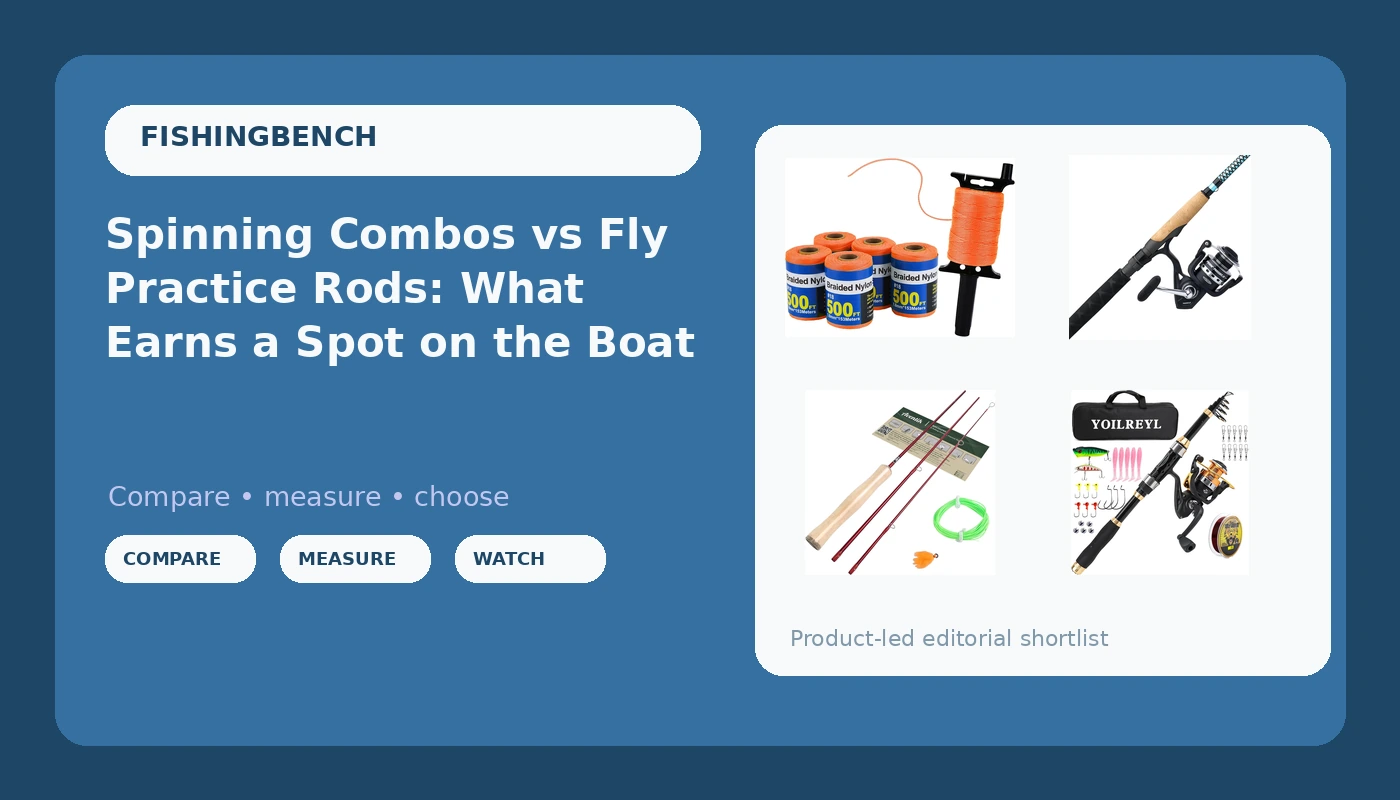
Most people who walk into my shop ask the same question in a different wrapper: which rod and reel should I buy first? The honest answer is that fishing rod and reel combos are not interchangeable, and the gap between a thirty-dollar telescopic kit and a proper inshore setup is not marketing fluff. It is guides, reel seats, and how the blank loads when a fish is pulling instead of posing. I spooled more line than most factories before I ever hung a shingle on a tackle shop, and I still fish a medium action rod that predates half my customers. So here is the plain version of what these four listings actually are, which job each one does, and which one does not belong on a rod at all.
Related: How to Set Drag on a Spinning Reel →
Quick answer
If you want one setup that covers inshore saltwater without a shopping list, the Ugly Stik Carbon Inshore Rod & Penn Pursuit IV Spinning Fishing Combo pairs an inshore-intent rod with a Penn Pursuit IV spinning reel in a single purchase. If the priority is a rod that collapses into a backpack or a suitcase, the Yoilrey telescopic starter kit is the travel option, and it arrives with line, a lure box, and a tackle bag. If you want to build casting mechanics before you spend real money, the Aventik Practice Fly Rod with Line is a trainer, not a fish-fighting tool. The Mason Line String Line is #18 braided nylon string sold for gardening and masonry work, so treat it as utility cord for the truck box, not as line you spool onto a reel.
Four useful options
| Model | Best fit | What stands out |
|---|---|---|
| Ugly Stik Carbon Inshore Rod & Penn Pursuit IV Spinning Fishing Combo | Inshore saltwater anglers who want one matched setup | Rod and Penn Pursuit IV spinning reel sold together as a combo |
| Yoilrey Fishing Rod and Reel Combo, 5.9ft Telescopic Fishing Pole Starter Kit | Travel, car camping, and first-timers | Telescopic 5.9 ft pole packaged with spinning reel, fishing line, lure box, and tackle bag |
| Aventik Practice Fly Rod with Line | Learning fly casting mechanics | Sold as a practice fly rod with line included |
| Mason Line String Line, #18 Braided Nylon String, 500 Ft | Marking, tying, and general utility work | 500 ft of #18 braided nylon string on a reloadable line reel |
The saltwater workhorse: Ugly Stik Carbon Inshore Rod & Penn Pursuit IV Spinning Fishing Combo
The trade-off with any combo is that you inherit somebody else's pairing. That is usually fine here, because a Penn Pursuit IV on an inshore rod is a sensible match, but it does mean you should read the listing for the rod length and action before you buy, since those two specs decide whether the rod suits your water. Check the guides and the reel seat when it lands. Those are the parts that fail first on any rod, and they are the parts a photograph will not tell you about. If the reel seat rocks in the blank or the guides feel rough under a fingernail, send it back before you fish it.
The travel kit: Yoilrey Fishing Rod and Reel Combo, 5.9ft Telescopic Fishing Pole Starter Kit
Here is the honest framing. Telescopic rods trade stiffness for packability, and a shorter blank casts a shorter distance, so this is not the rod I would hand a client on a charter. What it is good at is existing when you otherwise would not have brought a rod at all. It lives in a trunk or a duffel, and the included line and lure box mean nobody has to make a second trip. If you fish twice a year, this is plenty. If you fish twice a week, this is the backup, not the primary.
The casting trainer: Aventik Practice Fly Rod with Line
The trap with practice gear is expecting it to do a fishing rod's job. It will not, and that is not a flaw. Fifty hours of lawn casting on a practice rod will teach you more about loading and unloading a blank than any catalog description, and the habit transfers to whatever rod you eventually fish. Think of it as tuition you pay once, in a driveway, instead of in wind on the water.
The odd one out: Mason Line String Line, #18 Braided Nylon String, 500 Ft
I keep string like this in the shop. It marks a boundary, ties a tarp, bundles rod tubes, and holds a crab trap door shut. What it does not do is go on a spinning reel. Braided nylon string has no place in a drag system, and anybody who spools it is going to spend an afternoon untangling and an evening explaining. Buy it for the truck box if you need marking cord. Do not buy it for the boat.
Prices and availability may change. Product images, names, and retailer links are matched to verified listings. No current price, rating, stock status, or measured result is stated here without current evidence.
Action is the spec that matters, not the power label
Every rod you pick up has two numbers that get quoted and one that actually decides whether you enjoy fishing it. The quoted ones are length and the vague power word on the blank. The one that matters is action, which is simply how the rod bends when it loads. A fast action bends mostly in the tip, a moderate action bends through the middle, and a slow action bends deep toward the butt. None of those is better in the abstract. A fast tip rod casts tight loops and drives a hook, but it feels stiff and unforgiving to a beginner. A moderate rod loads easily at short range and forgives a sloppy cast, which is why so many all-around inshore rods sit in that middle ground.
Then there is backbone, which is the rod's power through the mid-section once a fish is on. You find that out by pulling, not by reading. A rod with a soft mid-section will bend into a U and let a decent fish find structure. A rod with real backbone stops the fish and lets you steer it. When a listing does not spell out action, that is not a reason to walk away, it is a reason to check the product page for the full spec sheet and to think about what you actually cast: live bait at short range, or a jig you need to move water with.
Guides and reel seats are where cheap combos fail
Nobody photographs the guides, and the guides are the rod. They are the rings that route your line, and every cast drags line across them. Rough or cheap guides groove over a season, and a grooved guide shreds line, which means you lose fish to a five-dollar part. Run a fingernail around the inside of each ring when a rod arrives. If it catches, send it back. If it is smooth, you have a fighting chance.
The reel seat is the other quiet failure point. It is the fitting that clamps the reel to the blank, and if it wobbles on a twenty-pound fish, the whole setup flexes in a place it was never designed to flex. Seat the reel, tighten it down, and try to rock it side to side. Any movement is a problem, and it will not get better with saltwater exposure. On a combo purchase you are evaluating both halves at once, so inspect the rod's hardware and the reel's fit as a single unit.
- Decide what you are actually fishing for, because a pond largemouth and an inshore redfish pull in different directions.
- Match the rod's action to your experience, with a moderate bend for newer casters and a faster tip for experienced ones.
- Check the reel seat and guides before the first trip, and return the rod if either one wobbles or feels rough.
- Match line class to the rod rather than to the fish story, because overloaded line breaks blanks, not just leaders.
- Buy the setup that fits the fishing you do most weeks, not the trip you take once a year.
Practical guidance for buying a first combo
- Read the full product page for rod length, action, and line rating before you buy, since a combo listing often leads with the reel.
- Treat bundled line as a starting point, not a permanent answer, and plan to respool once you know what you are casting.
- Keep a telescopic rod as a travel or backup setup and accept the shorter casting range that comes with it.
- Use practice gear to build timing, then move that timing onto the rod you actually fish with.
- Never put braided nylon utility string on a reel, no matter how much of it comes on the spool.
Which option should you choose?
Choose the Ugly Stik Carbon Inshore Rod & Penn Pursuit IV Spinning Fishing Combo when your water is salt and you want one matched rod and reel you can fish hard without assembling a kit. Choose the Yoilrey Fishing Rod and Reel Combo, 5.9ft Telescopic Fishing Pole Starter Kit with Spinning Reel, Fishing Line, Lure Box & Tackle Bag for Travel when portability and a complete first setup matter more than casting distance. Choose the Aventik Practice Fly Rod with Line when you want to learn fly casting mechanics on grass before you commit to a fly setup. Buy the Mason Line String Line only if you need marking cord around the yard, the shop, or the truck.
One caveat worth repeating: this comparison is built from what the listings actually state, not from a season of testing on my part. Specs such as action, line rating, and rod length vary by model, so verify them on the product page, and inspect the hardware in your hands before the return window closes. A rod is a tool, and the fish will tell you whether you chose right.
The bottom line
Three of these four listings are fishing gear and one is not, and separating them is most of the work. The inshore combo is the serious setup, pairing a rod built with saltwater intent and a Penn Pursuit IV spinning reel. The telescopic kit is the one that actually travels. The practice fly rod is the cheapest way to learn a hard skill before you spend real money on it. And the braided nylon string stays in the shop, where it belongs. Match the rod to the fish you catch most weeks, inspect the guides and the reel seat the day it arrives, and you will get more seasons out of a modest combo than most people get out of a display piece.