Most telescopic rod and reel combos die the same death. Somebody buys one for a trip, extends it in the driveway, casts it twice, then spends the first morning of vacation picking at a backlash the size of a softball while fish boil twenty feet away.
None of that is the rod's fault. A telescopic rod and reel combo is a compromise, and it is a good one if you understand what you gave up and set the thing up accordingly. You gave up some sensitivity because you added five or six ferrule joints between your hand and the lure. You gained a rod that lives in a backpack, a boat locker, or the trunk of a rental car, which is the difference between fishing on your trip and not fishing on your trip.
I have been rigging travel rods for clients for 24 years, first as a charter captain out of Destin and now from behind the counter of my tackle shop. Here is the setup routine I walk people through, plus the two kits I would actually hand to somebody who wants to fish on vacation without checking a rod tube.
Why you should trust me
I ran charters out of Destin until my knees said no, and I have spent the years since testing rods and running a tackle shop. Every rod that comes across my counter gets the same treatment: real fishing trips, a backbone pull against a heavy drag, and a casting test from both a beginner and an expert. I keep a logbook of action curves because a rod's power rating is marketing and its action is engineering.
What that means for you is simple. I do not care what the box says the rod can do. I care how it loads on a cast, whether the backbone holds when a fish turns, whether the guides survive a season, and whether I would hand it to a paying client. That is the test every rod gets.
How I judge a telescopic combo before I recommend it
Telescopic rods have more failure points than a one-piece, so the inspection list is longer, not shorter. Three things decide whether a travel combo is worth your money.
The guides and the ferrules. Guides route your line, and cheap ones groove and shred it. On a telescopic rod you have more guides and more joints, which means more places for grit to hide and more places for a ring to crack. Run a cotton swab around the inside of every ring. If it snags, the ring will eat your line.
The reel seat. A wobbly reel seat on a fish is a disaster waiting to happen. Seat the reel, tighten it down, and try to rock it side to side. If the seat moves, the rod moves. On a travel combo this is the check I do first, because the seat takes more abuse in a bag than it does on a rack.
The line and the drag. Pre-loaded line is convenient, not guaranteed. Drag washers in a budget reel need to run smooth from light to heavy, and the line needs to match the reel's rating. A reel spooled with line heavier than its drag can manage is a reel that will fail at the worst moment.
I also care about balance. A short telescopic rod with a heavy reel feels tip-light and casts like a broomstick. The combos below are matched reasonably well out of the box, which is the whole reason a combo makes sense for travel.
The two combos worth packing
These are the two kits I would point a traveling angler toward, one for a single rod in a backpack and one for a couple or a family. Both are starter kits, and I mean that as a compliment. Starter money, real fishing.
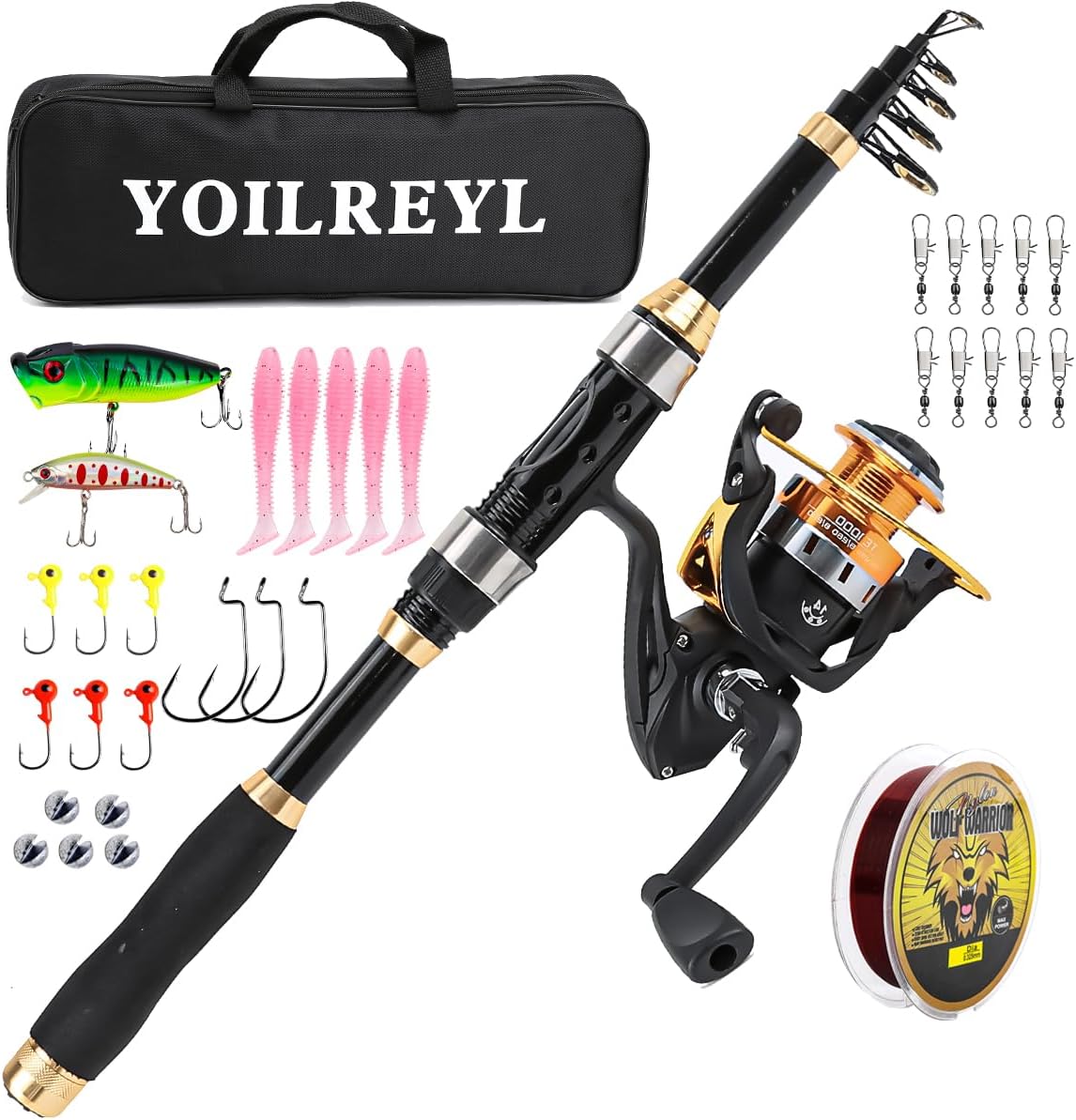
Budget pick: Yoilrey Fishing Rod and Reel Combo, 5.9ft Telescopic Fishing Pole Starter Kit with Spinning Reel, Fishing Line, Lure Box & Tackle Bag for Travel
 Visit on Amazon →
This is the one-rod answer. A 5.9 foot telescopic pole, a spinning reel already loaded with line, a small lure box, and a tackle bag that holds the whole thing. If you are flying somewhere and you want to fish a dock, a pond, or a shoreline without dragging a rod tube through an airport, this is the shape of kit that actually travels.
The honest caveat is the length. At 5.9 feet you have less leverage and less casting distance than a 7 foot rod, and that matters if you are trying to reach a school of fish busting 60 yards out. Where it shines is close work: panfish off a dock, trout in a creek, school bass along a seawall. The included lure selection is a starting point, not a plan. Swap in two or three baits you trust for the water you are actually fishing and leave the rest at home.
Flaws but not dealbreakers: Short rods are tip-heavy with a reel mounted, and a 5.9 foot telescopic is no exception. It also will not handle big saltwater fish. This is a light tackle kit. Treat it that way and it will serve you for years.
Anyone flying with carry-on only, or anybody who wants one rod behind the truck seat, should start here.
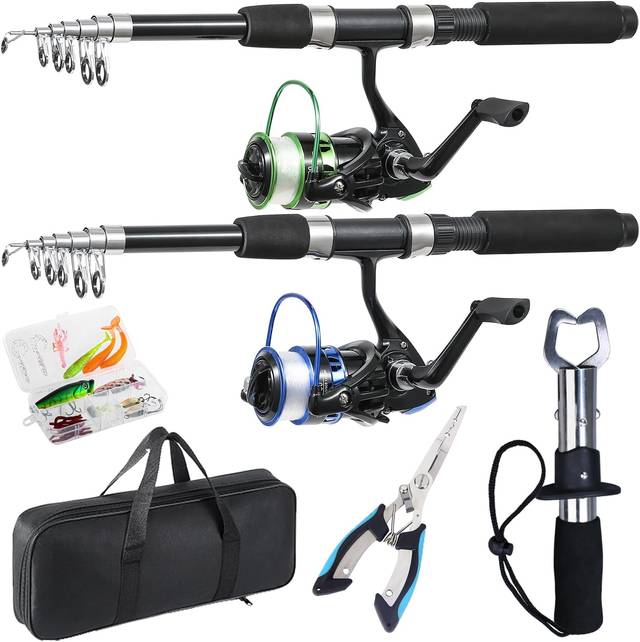
Our pick: Tripquips Fishing Rod, 2PCS Telescopic Fishing Rod and Reel Combo with Fishing Pliers and Lip Gripper, Pre-Loaded Spinning Reel Combo, Fishing Pole with Carrier Bag Fishing Gear
 Visit on Amazon →
Two rods, two pre-loaded spinning reels, a pair of fishing pliers, a lip gripper, and a carrier bag. That is a vacation kit for two people, or a kit for one person who wants a backup rod in the bag because rods break and trips do not wait.
The pliers and the lip gripper are the parts I care about most, and they are the parts most starter kits skip. Pliers cut line, open split rings, and get a hook out of a fish's mouth without you putting your fingers near trebles. A lip gripper lets you land a fish, hold it still, unhook it, and release it without a wrestling match. If you are teaching a kid to fish, those two tools do more for fish survival than any hook choice you make.
Flaws but not dealbreakers: Two rods mean two reels to maintain, two drags to check, and twice the line to inspect before a trip. That is real work, and if you only ever fish alone, the single-rod kit above does the same job with half the upkeep. The carrier bag also holds two rods and not much else, so pack your terminal tackle separately.
A couple, a parent and a kid, or anyone who wants a spare rod on the road will get more out of this kit than a single-rod setup.
The setup, step by step
Now the part that decides whether the trip goes well. Do this at home, not in a parking lot.
Step one: inspect it before you pack it. Extend the rod fully. Run a cotton swab or a piece of nylon stocking around the inside of every guide ring and look for snags. Wipe each ferrule with a dry cloth. Check the reel seat threads for grit and the drag knob for smooth travel. Ten minutes here saves a trip.
Step two: extend it tip first. Hold the rod tip in one hand and let the sections below seat as you work down toward the butt. Give each joint a slight quarter turn to seat it. Do not yank sections apart to extend them and do not force a joint that will not seat. If a joint sticks, back it off, wipe it, and try again. A little paraffin on a stubborn ferrule works wonders.
Step three: align the guides. Sight down the rod from the butt. Every guide should sit on the same line as the reel seat. If one is rotated 30 degrees off, your line will slap the blank on every cast and you will lose distance and accuracy.
Step four: mount the reel and kill the wobble. Seat the reel foot in the reel seat and tighten the hood down firmly. Now grab the reel and try to rock it. If it moves, tighten more. Recheck this after your first ten casts, because new seats settle. A wobbly reel seat is the most common cause of a combo that feels cheap when it is actually just loose.
Step five: deal with the line. Strip 20 to 30 feet off the spool and run it through your fingers. Line that coils tight and feels wiry has memory, and memory turns into tangles. If it is bad, respool with fresh line matched to the reel's rating. Fill the spool to about an eighth of an inch below the lip. Overfilled spools throw loops. Underfilled spools cost you distance.
Step six: set the drag by hand. Pull line off the spool by hand and feel for smooth resistance from light to heavy. Set the working drag at roughly a quarter of your line's breaking strength so a fish can take line without snapping it. If the drag stutters or grabs, back it off and start again. Smooth beats tight every single time.
Step seven: tie on properly. A Palomar or an improved clinch knot, tied with wet line, seated tight. Trim the tag end close. Retie after every fish that roughs up the last few inches of line above the knot.
Step eight: cast slower than you think. A telescopic rod with a lot of joints loads differently than a one-piece. Let the rod do the work. A smooth, slightly slower stroke loads the blank and unloads it without a backlash. Overpowering a telescopic rod is how people spend vacation picking at their reel.
Step nine: break it down the right way. Collapse from the butt end, not the tip. Wipe every section dry before it goes back in the bag. Never store a rod wet, and never leave a combo in a hot car trunk for a week. Heat and moisture are what kill ferrule joints and corrode guide frames.
The competition and why it lost
A telescopic combo is not the best rod you can own. It is the best rod you can carry, and those are different questions.
If you fish the same water every weekend and you drive there, a two-piece rod beats a telescopic every time. Fewer joints, better sensitivity, a cleaner action curve. A one-piece rod beats both. The trade you make with a telescopic is sensitivity and casting distance for portability, and that trade is worth it exactly when portability is the problem you are solving.
The other thing a telescopic combo is not is a big fish rod. The added ferrules and the shorter lengths mean less backbone through the mid-section, which is the part that turns a fish. For panfish, trout, school bass, and pier fishing, you will never notice. For anything that pulls drag in a serious way, you want a rod built for it, which is a different article and a different budget.
What you should not do is buy a telescopic combo and then spend money upgrading it. A rod that costs real money and then needs new guides, a new reel seat, and a new reel is not a bargain. Buy the kit that matches the fish you actually catch, not the one in the catalog photo.
What this all costs
Both kits are starter money. Check current Amazon price on each and do the cost-per-trip math instead of the sticker math. If a kit gets you on the water three mornings of a week-long trip, and it does that for three or four trips before you outgrow it, the cost per morning is coffee money. That is the whole argument for owning one.
What you are really buying with a travel combo is the option to fish at all. No rod tube, no checked bag fee, no rental rod that has been dragged across a thousand piers. The setup routine above takes twenty minutes at home and maybe two minutes on the water once you have done it twice.
Do it once in your driveway before the trip. Extend it tip first, align the guides, seat the reel, check the drag, and cast it a dozen times. Then collapse it, wipe it down, and pack it. When you get where you are going, you will spend your first morning fishing instead of fixing. That is the job. The rod is a tool, and the fish is the review.