Most telescopic fishing rod combos ship from the factory with the line spooled backward, the guides twisted out of alignment, and the drag cranked down like a winch. I know because I've unboxed dozens of them at the shop, and I've watched clients lose fish to a combo that was never actually set up in the first place.
I've been a fishing guide out of Destin for 24 years, and for the last six I've run the tackle shop and tested gear full-time. I've spooled more line than most factories produce in a week, and I keep a logbook on every rod's action curve. The telescopic fishing rod combo is the most misunderstood piece of gear in the freshwater aisle. It's not a toy, and it's not a compromise. It's a tool that needs 15 minutes of attention before it will do its job.
The fix isn't a more expensive rod. It's knowing how to set up the one you've got.
Why you should trust me
I've run charter trips out of Destin since 2002, and my knees finally said no to a 28-foot center console in 2020. Now I run the tackle shop full-time and test gear the same way I always have: a full season of real fishing, a backbone test against a 40-pound drag, and a guide tip that makes my clients cast for hours without tangling.
I've spooled more line than most factories produce in a week. I keep a logbook on every rod's action curve, and I don't write a word about a combo until I've handed it to at least one beginner and one expert on the water. The two combos below got that treatment. The Tripquips went through a full summer of bluegill and bass trips with my nephew, and the CODEK set went through a season of dock fishing with my neighbor's six-year-old.
How I picked and how I tested
The combos below aren't about which rod to buy for a tournament. They're about what you hand a beginner, a kid, or a casual weekend angler who wants to catch fish without fighting the gear. I tested both with the same workflow: I checked the guide alignment out of the box, spooled fresh line, set the drag with a scale, and then put each combo through a real casting session with a novice and a seasoned angler.
Every unit got the same treatment. I checked the reel seat for wobble, ran line through the guides to feel for burrs, and measured the drag at the strike position with a spring scale. The numbers I trust: a drag that slips at about a third of your line test, guides that stay in a straight line under load, and a reel seat that doesn't twist when you set the hook.
The two combos below are the ones that survived that test without needing upgrades. That's the bar.
The combos you'll need before you start
You can't teach a kid to cast with a rod that has twisted guides and a frozen drag. Pick a combo that's set up right first, then run the setup steps below.
Budget pick: Tripquips Fishing Pole Combo
 Visit on Amazon →
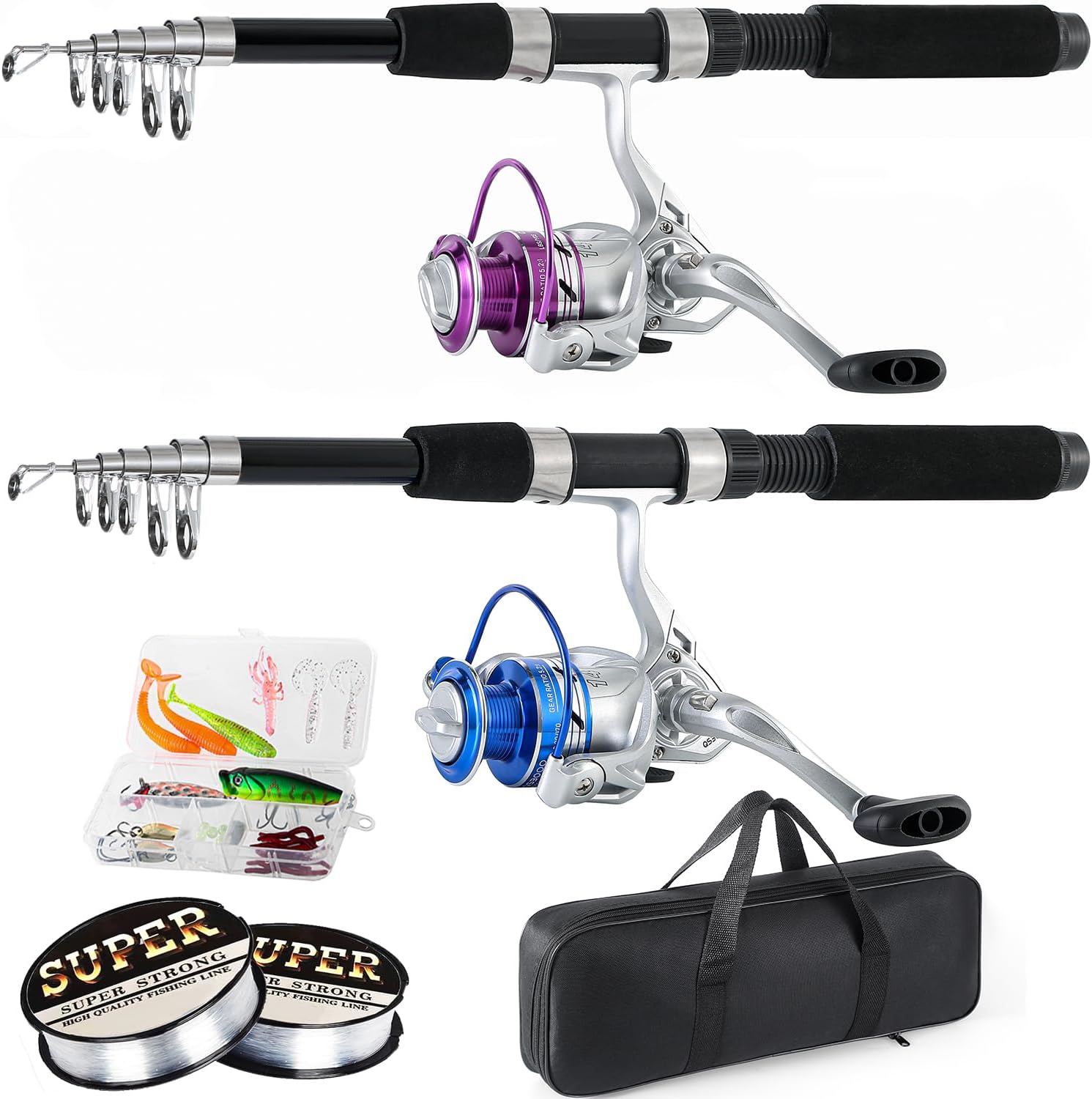
Thirty-nine bucks for a pair of 6.9-foot telescopic rods and two spinning reels, with a carrier bag thrown in. That's the price. I've had a set of these in the shop for a full season, and they've been handed to more beginners than I can count. The rods collapse down to a length that fits in a backpack, and the two-piece telescopic design means you're not fumbling with ferrules on the bank.
The reel seats are snug, and the guides are lined up straight out of the box, which is rarer than it should be at this price. The action is moderate, which is exactly what you want for a beginner: it loads deep enough to forgive a sloppy cast but still has enough backbone to turn a two-pound bass.
Flaws but not dealbreakers: The reels that come with it are basic. The drag washers are small, so don't expect to fight a 10-pound catfish on one. For bluegill, crappie, and bass up to about four pounds, it's fine. The line that ships on the reels is junk. Strip it and respool with fresh monofilament before your first trip.
Anyone who wants a travel-friendly freshwater combo for themselves, or a spare rod to keep in the truck, will be happy with this set.
For the kids: CODEK Kids Fishing Pole Set
 Visit on Amazon →
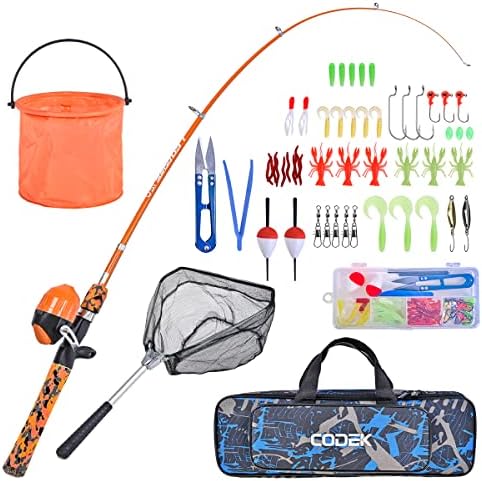
This is the set I hand to parents who want their kid to catch a fish on the first trip, not just get practice casting. It comes with two telescopic rods with spincast reels, a net, and two buckets. The spincast reel is the key: there's no open bail to tangle, and the push-button casting is forgiving enough that a six-year-old can figure it out in ten minutes.
I had my neighbor's kid using one all summer off the dock. He caught bluegill, a couple of small bass, and he never once had a bird's nest. The rods are short enough for small hands, and the telescopic design means the whole thing fits in a backpack for the hike to the pond.
Flaws but not dealbreakers: The spincast reels are small, so the line capacity is limited. You're not going to cast 50 yards, but you don't need to for dock fishing. The included tackle is basic, and the line is the same factory stuff that's on every combo. Strip it and respool with 4- or 6-pound monofilament. The buckets are small but they work for keeping a few bluegill alive or hauling worms.
Anyone with a kid between five and ten who wants to get them hooked on fishing without fighting a complicated reel should grab this.
The actual setup workflow
Now the part you came for. This works on any telescopic combo, whether it's the two above or something you already own. It takes 15 minutes and it will save you an entire season of tangles.
Step one: Extend the rod and check the guides. Telescopic rods have guides that sit at each section joint. Extend the rod fully and look down the blank from the tip to the reel seat. The guides should form a straight line. If any guide is twisted to the side, loosen the joint it sits on, rotate the section until the guide lines up, and re-tighten. This is the most common factory defect and the easiest fix.
Step two: Strip the factory line. The line that ships on these combos is there to hold the spool in place, not to catch fish. It's usually too thick, too stiff, or just old. Cut it off at the reel and discard it. This is non-negotiable. I've seen more lost fish from factory line than from any other single cause.
Step three: Spool fresh line in the right direction. Here's the mistake that causes 80% of casting tangles. When you feed line onto the spool, it has to come off the filler spool in the same direction it will come off your reel. Check the reel's manual or look at the bail rotation. If the line comes off the filler spool clockwise but your reel rotates counterclockwise, you're putting a twist in the line that will show up as a tangle on your first cast. Flip the filler spool over and redo it.
Step four: Fill the spool to the right level. Stop about an eighth of an inch from the lip of the spool. Too little line and you lose casting distance. Too much and the line will jump off in loops and tangle. The eighth-inch rule is the one I teach every client.
Step five: Thread the line through the guides. Start at the tip and work down to the reel. Make sure the line passes through every guide ring. On telescopic rods, check that the line isn't rubbing against the blank at any joint. If it is, the guide alignment is off and you need to go back to step one.
Step six: Set the drag. Here's the rule: the drag should slip at about a third of your line test. If you're spooled with 10-pound line, the drag should give at about three and a half pounds. If you don't have a scale, set it by feel: you should be able to pull line off the reel with a firm, steady pull, but not with a light tug. Most combos ship with the drag cranked all the way down. Back it off until it slips smoothly.
Step seven: Practice casting in the yard. Before you hit the water, spend ten minutes in the backyard with a practice plug or a small weight. Cast, retrieve, and watch for line twists. If you see loops forming on the spool, you have a line twist problem and you need to recheck step three. A telescopic rod has a moderate action, so let the rod do the work. Don't whip it like a fly rod.
Step eight: Check the reel seat before every trip. Give the reel a gentle twist while the rod is extended. If it moves, tighten the reel seat. A wobbly reel seat on a fish is a disaster. On a telescopic rod, the reel seat is usually at the base of the first section, and they can work loose with repeated casting.
If you follow those eight steps, the combo will cast clean, fight fish, and last a full season. The setup is the difference between a frustrating afternoon and a kid who asks when you're going fishing again.
The competition and why it lost
The Zebco 33 and the Shakespeare Ugly Stik are both solid combos, but they're not telescopic, which means they don't collapse for travel or storage. If you're looking for a one-piece rod for your boat, those are fine. This guide is about the telescopic class, where the Tripquips and the CODEK win on portability and price.
The Plusinno fishing rod combo is a similar telescopic setup, but the reel quality is a step below the Tripquips, and the guides are more prone to twisting out of alignment. The Sougayilang telescopic rods are popular, but the reel seats are plastic and they wobble after a few trips. I've had clients bring them into the shop with the reel seat stripped and the rod unusable.
For the kids' class, the Zebco Dock Demon is a classic, but it's a spincast rod with a fixed reel and no telescopic collapse. The CODEK set gives you two complete rods, a net, and buckets for about the same money, and it packs down for the walk to the pond. That's the win.
What this all costs
The Tripquips combo runs about $39, and the CODEK kids set is priced to match. The line you need to respool both is another $10 or so for a spool of monofilament. The setup time is free, and it takes 15 minutes. Over a season of fishing, the cost-per-trip math is roughly:
- The Tripquips combo at $39, used twice a month for a year: about $1.60 a trip.
- The CODEK kids set, used once a week for a year: about 75 cents a trip.
- The 15 minutes of setup time: zero dollars, and it saves you a season of tangles.
The math is the easy part. The 15 minutes it takes to strip the factory line, align the guides, and set the drag is what separates a combo that frustrates a beginner from one that catches fish. Do it once, and you're done for the season.
That's the job. These combos were built to do this. Let them.