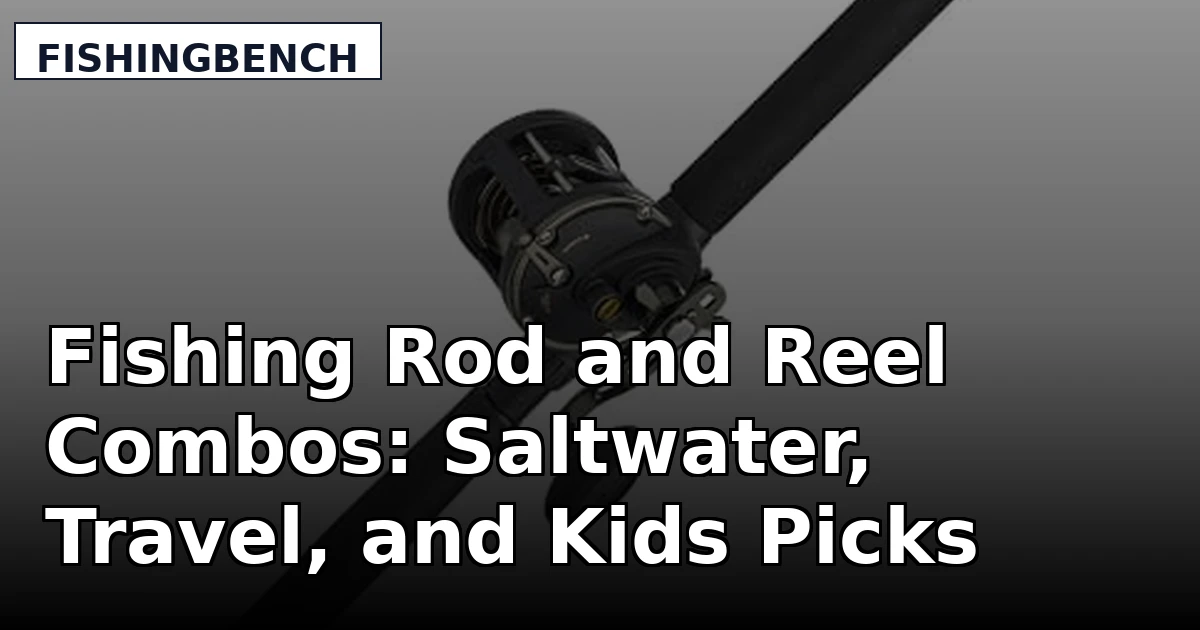
Fishing rod and reel combos look like the simplest purchase in the sport: one box, one price, everything already matched. In practice, the label tells you very little about what the combo will do on the water. A one-piece 6 foot 6 conventional setup and a 6.89 foot telescopic pair are both sold as combos, and they share almost no DNA. One is built to fight fish in salt water, the other is built to disappear into a carry bag. That gap matters most for two buyers: the angler stepping into saltwater for the first time, and the parent buying a first pole for a child who may or may not still care about it by August. This explainer walks through four combos, what each is actually designed to do, and the specs worth checking before money changes hands.
Related: Rod Action and Backbone, Explained for Real Anglers →
Quick answer
There is no single best fishing rod and reel combo, because the right pick depends on where you fish and who is holding the rod. For saltwater work from a boat, pier, or inshore flat, the Penn Squall II level wind combo is the one built for that job, with a one-piece 6 foot 6 rod and a level wind reel. For travel and storage, the 2-pack telescopic kit packs down into a bag. For a child, a kids kit sized to the child beats any adult combo you hand down. Match the combo to the water and the angler first, then compare features.
4 useful options
| Model | Best fit | What stands out |
|---|---|---|
| Penn 6'6" Squall II Level Wind Saltwater Rod and Reel Fishing Combo | Boat, pier, and inshore saltwater | One-piece 6 foot 6 rod paired with a level wind reel |
| 2-Pack 6.89FT Telescopic Fishing Rod Reel Combo Tackle Box Travel Carry Bag | Travel, trunk storage, spares | Two complete telescopic setups plus a tackle box and carry bag |
| WIDDEN Kids Fishing Pole with Reel Beginner Kit for Boys Girls Ages 3-12 | First pole for a child | Complete beginner kit aimed at ages 3 to 12 |
| Kids Fishing Pole for Boys, Girls & Youth Age, Toddler Fishing Pole Set Kit | Toddler and youth first trips | Sold as a full set kit for the youngest anglers |
Saltwater pick: Penn 6'6" Squall II Level Wind Saltwater Rod and Reel Fishing Combo
A level wind reel is not a casting reel in the way most freshwater anglers mean it. The line guide travels side to side as you crank, laying line evenly, which matters when you are dropping bait straight down or slow trolling and the line goes out under tension rather than off a free spool. That is why this pairing makes sense for saltwater bottom and boat work. The trade-off is honest: a one-piece 6 foot 6 rod does not break down, so it does not ride in a compact car trunk or a suitcase. If your fishing happens within driving distance of the water, that is a non-issue. If it does not, look at the telescopic kit below instead.
Travel pick: 2-Pack 6.89FT Telescopic Fishing Rod Reel Combo Tackle Box Travel Carry Bag
Telescopic rods solve one problem very well: length when you are not fishing. A 6.89 foot rod that collapses to something that fits in a duffel is the difference between fishing on a trip and leaving the gear at home. The cost is in the joints. Every telescopic blank has sliding sections, and those sections are where flex gets less predictable and where grit and salt collect if you do not rinse and dry the rod after each trip. That does not make it a bad choice. It makes it a specific choice: this is the kit for the angler who fishes a handful of times a year, travels, or wants a spare setup behind the seat. Two rods also means you can hand one to a friend.
Kids pick: WIDDEN Kids Fishing Pole with Reel Beginner Kit for Boys Girls Ages 3-12
The single biggest mistake in kids fishing gear is scale. An adult combo handed to a seven-year-old is too long, too heavy, and too far from the hand position a small angler can actually control. A pole sized to the child lets them cast, hold the rod tip up, and feel a bite without fighting the tackle. This kit is aimed at the 3 to 12 range, which is a wide spread, so think about the child's size rather than the number on the box. A five-year-old and an eleven-year-old will want different lengths. The other consideration is durability, because a kids pole gets dropped on rocks, stepped on in the truck bed, and used as a walking stick.
Toddler and youth pick: Kids Fishing Pole for Boys, Girls & Youth Age, Toddler Fishing Pole Set Kit
This one sits at the younger end of the kids market, which changes the job description. With a toddler or a very young child, you are not really teaching casting. You are managing attention span and safety, and you want gear light enough that the child can hold it upright without help for a few minutes at a time. Bait under a bobber at a dock or a stocked pond is the realistic use case. Set expectations accordingly: a first trip is a success if the child holds the pole, watches the bobber, and wants to come back. Fish caught are a bonus.
Prices and availability may change. Product images, names, and retailer links must be matched by verified ASIN. Do not state a current price, rating, stock status, or measured result without current evidence.
How rod action and backbone actually work
Action describes where a rod bends, and it is the spec that decides whether a combo feels right in your hand. A fast action bends mostly in the top third, which gives you a quick tip and a stiff mid-section. A moderate action bends through the middle, which loads more smoothly and forgives a sloppy cast. A slow action bends deep into the butt, which is rare in modern graphite and mostly found in fiberglass and cane. Power is a separate number, and it describes how much weight it takes to load the rod, not how strong it is. Backbone is the mid-section doing its job once a fish is on: it is what lets you turn a fish instead of just following it around.
Two rods can both say medium power and fish completely differently, which is why the bend matters more than the label. When you pick up a combo, flex the tip against a ceiling or a wall and watch where the curve starts. If the bend runs past the middle of the blank, that rod will feel soft on a hookset. If the bend barely reaches the second guide, it will feel like a broomstick on a small fish. The right answer depends on your target species and how you cast, not on the marketing line.
Guides, reel seats, and the parts that fail first
The blank gets all the attention, but the hardware is what ends a rod's life. Guides route the line, and the ring material inside them determines how fast they wear. A grooved guide shreds line, and a shredded line costs you fish. Rinse guides with fresh water after every saltwater trip, and run a cotton swab inside the ring: if it snags fibers, the ring is damaged.
The reel seat is the other failure point. It holds the reel, and any wobble there transfers directly into the fight. A loose reel seat on a strong fish is a disaster waiting to happen, and it usually shows up as a reel that shifts under load rather than one that falls off. Check the seat with the reel mounted and the drag set, then twist. If the reel moves in the seat, tighten the hoods and check again.
- Decide where you actually fish: boat, pier, pond, or travel water.
- Decide who holds the rod, because a child needs a different length and weight than an adult.
- Flex the blank and note where the bend starts before you look at the label.
- Inspect the guides for smooth rings and the reel seat for a solid lockup.
- Rinse and dry the rod after every saltwater trip, telescopic sections especially.
Matching a combo to the water you actually fish
- Boat and pier saltwater work favors a one-piece rod with a level wind reel, because even line lay matters more than casting distance.
- Inshore casting favors a spinning setup with a fast tip, since you are casting repeatedly and need the rod to load quickly.
- Travel and occasional use favors telescopic blanks, accepting the joint trade-off in exchange for portability.
- Kids under about eight favor a short, light pole sized to them, fished with a bobber and bait rather than lures.
- Any combo used in salt water needs a fresh water rinse on the guides, reel seat, and reel, every single trip.
Which option should you choose?
Choose the Penn 6'6" Squall II Level Wind Saltwater Rod and Reel Fishing Combo when your fishing happens from a boat, a pier, or inshore water and you want one saltwater-ready package. Choose the 2-Pack 6.89FT Telescopic Fishing Rod Reel Combo Tackle Box Travel Carry Bag when portability and a spare setup matter more than a one-piece blank. Choose the WIDDEN Kids Fishing Pole with Reel Beginner Kit for Boys Girls Ages 3-12 when you are buying a first pole for a child in that age range. Choose the Kids Fishing Pole for Boys, Girls & Youth Age, Toddler Fishing Pole Set Kit when the angler is a toddler or very young child and the trip is really about the experience.
One caveat worth stating plainly: combo specs on a listing describe the build, not the fishing. Action ratings do not always match the actual bend, and a rod that feels right in the store may feel wrong after an hour of casting. If you can, handle the combo before you commit, or buy from a seller with a return policy you can live with.
The bottom line
The combo that works is the one matched to your water and your angler. Saltwater boat and pier fishing rewards a one-piece rod with a level wind reel and hardware that can take a rinse and keep going. Travel and occasional fishing rewards a telescopic kit that actually makes it into the truck. Kids fishing rewards scale, because a child who can hold the rod up and feel a bite will want to come back, and that matters more than any spec sheet. Check the guides, check the reel seat, and buy for the fish you actually catch.