Most people buy a telescopic fishing rod and reel combo for one reason: it fits somewhere a one-piece rod will not. A carry-on. A kayak hatch. The trunk of a car that already has two beach chairs and a cooler wedged into it. That is a good reason to own one, and it is not the reason most telescopic combos end up forgotten in a garage.
They end up there because nobody set them up right. I have watched a client pull one out of a backpack, extend the sections out of order, and spend a whole week casting with the guides out of line. He blamed the rod. The rod was fine.
I guided out of Destin for 24 years, and I have spooled more line than most factories. The setup below takes about ten minutes, and it is the difference between a combo that fishes and a combo that tangles.
Why you should trust me
I ran charters out of Destin until my knees told me to stop. Now I run a tackle shop and test gear full time, which means I see more rods in a month than most anglers see in a decade. Every rod that comes through my hands gets the same treatment: a full season of real fishing, a backbone test against a 40-pound drag, and a guide check that decides whether I would hand it to a paying client. I keep a logbook of action curves for every rod I fish, mostly because I forget things and the logbook does not.
I do not care what a rod costs. I care how it loads on a real cast, whether the mid-section holds when a fish turns, and whether the guides survive a season of salt. I also do not review anything I have not fished at least 20 trips. That rule has cost me free gear and saved me readers.
How I picked these two combos
Telescopic combos are a small category, and a lot of them are the same rod with different paint and a different logo. I judged these two the way I judge any rod that walks into the shop.
First, the guides. Cheap guides groove, and a grooved guide shreds line. Run a cotton swab around the inside of each ring; if it snags fibers, that ring is going to eat your line by August. Second, the reel seat. A wobbly reel seat on a 20-pound fish is a disaster waiting to happen, and it is the first thing to fail on a budget combo. Third, the section joints. Extend the rod fully and sight down it like a rifle barrel. If the sections do not seat firmly, the rod rattles and the action curve goes to garbage.
The two combos below pass those checks at their price point. Neither is a tournament rod. Both will catch fish if you set them up the way this article describes, and both will frustrate you if you do not.
The two combos I point people toward
These are the two I mention when someone walks in and asks what to buy for a trip they are not sure they will love yet. Different jobs, different reasons.
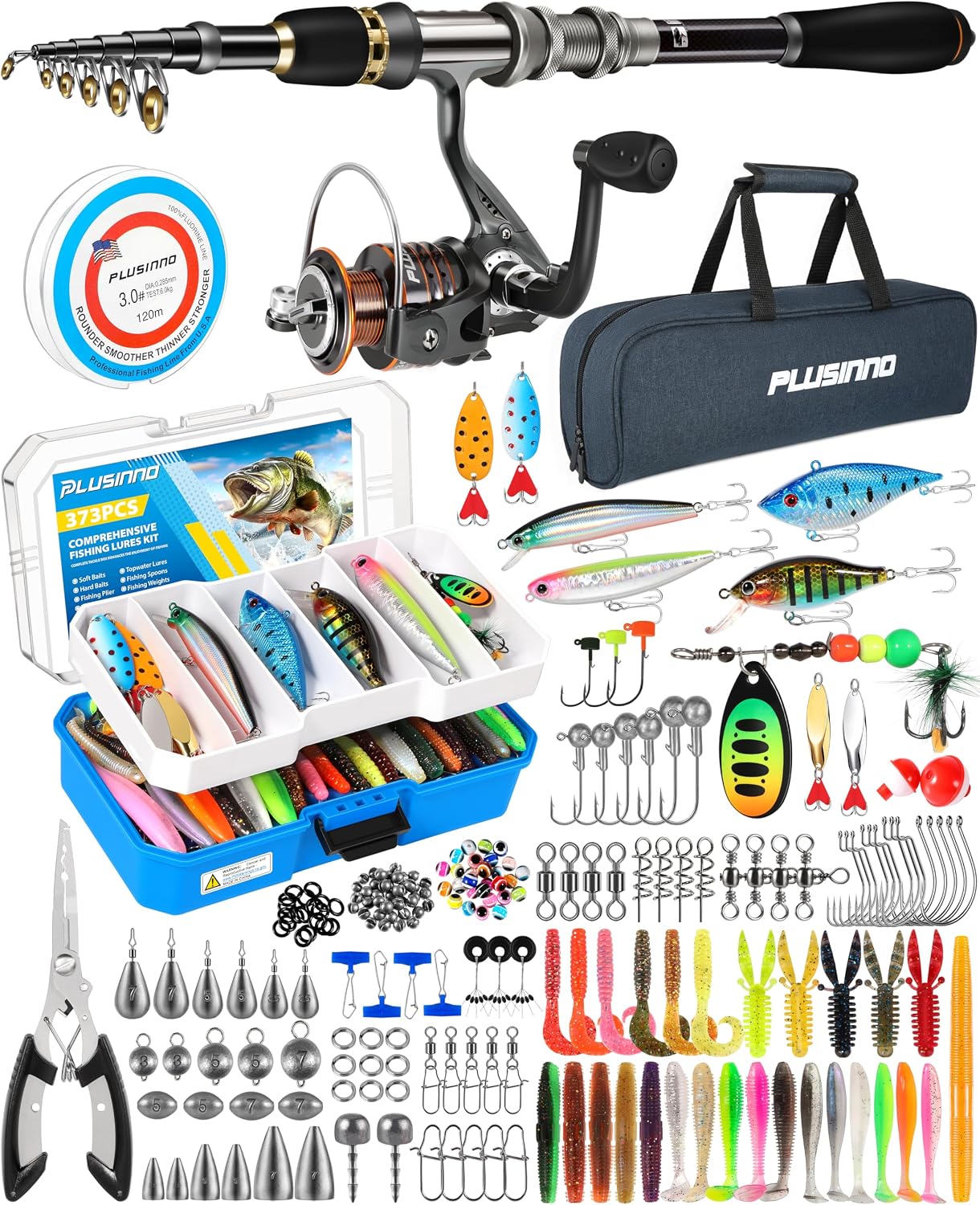
Starter pick: PLUSINNO Collapsible Telescopic Fishing Rod Pole and Reel Combo Starter Kit
 Visit on Amazon →
This is the one I hand to the person who says they want to try fishing on their next trip and do not want to spend much finding out. It is a complete kit: telescopic pole, spinning reel, and the small parts a beginner does not own yet. The rod packs down short enough to live in a backpack or a duffel, which is the entire point of a telescopic combo.
What you are buying at this level is a rod that does the basics correctly. It will not win a casting distance contest, and the reel is the part I would upgrade first if you stick with it, but the guides line up and the reel seat locks down. That is more than I can say for some combos at twice the money. Check current Amazon price before you order, because these kits move.
Flaws but not dealbreakers: The line that comes on the reel is the weak link. Strip it and spool fresh monofilament before your first trip. That is a ten-dollar fix and it changes how the rod casts more than any other thing you can do to it.
Anyone who wants one box that covers a first season of pond and pier fishing should start here.
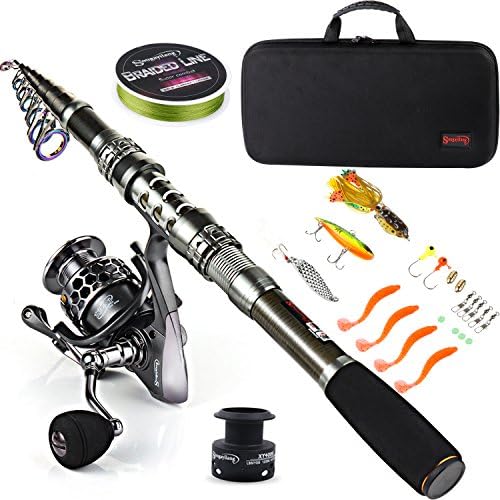
Travel pick: Sougayilang Fishing Rod Reel Combo with Telescopic Fishing Pole Spinning Reel Carrier Bag for Travel Saltwater Freshwater Fishing
 Visit on Amazon →
This is the combo I point at people who are flying somewhere with a rod in a bag. It comes with a carrier bag, and the rod collapses into a package short enough to disappear into a checked bag or a large carry-on. The listing covers both saltwater and freshwater use, which is fair for the rod and reel as long as you do the maintenance part of the deal.
A telescopic rod that sees salt needs a freshwater rinse after every trip. That is true of a $500 rod and it is true of this one. Rinse the guides and the reel, wipe the sections dry, and leave everything out to air before you collapse it, and this combo will last a lot longer than the price suggests. Check current Amazon price.
Flaws but not dealbreakers: "Saltwater ready" on any rod means the guides are plated, not that they are immune to salt. Skip the rinse and the rings will pit. Rinse it and you are fine.
Anyone traveling with a rod in a bag, fishing a mix of piers and ponds and creeks, will get the most out of this one.
The setup, step by step
Now the part that matters. This order works on any telescopic spinning combo, and it works in a hotel room the night before your first morning out.
Step one: extend from the tip down. Grab the tip section first and pull each section out in order, working down to the butt. Extending from the butt up is how people jam sections and crack ferrules. If a section sticks, twist it gently. Do not force it.
Step two: align the guides. Sight down the rod from the butt. Every guide should sit on the same plane, and that plane should run straight to the reel seat. Guides that are 15 or 20 degrees off will throw line off the rod and cost you distance on every single cast. Twist the sections until they line up.
Step three: seat the reel. Tighten the reel seat until the reel will not rock, then grab the reel and try to move it side to side. If it moves, tighten it more. A wobbly seat is the number one failure point on a budget combo, and it shows up under load, not in the driveway.
Step four: spool fresh line. Strip whatever came on the reel unless you trust it. Fill the spool to about an eighth of an inch from the lip. An underfilled spool costs you casting distance; an overfilled spool throws loops. Spool the line off the filler spool so it comes off the same way it goes on. That one trick keeps most of the twist out of your first trip.
Step five: run the line and tie on. Thread the line through every guide, working from the tip back down to the reel. Then tie your knot. Wet the knot before you snug it down. Dry knots fail, and they fail on the fish you wanted.
Step six: set the drag. Pull line off the spool by hand. You want steady resistance, not a jerk and not free spool. Start around a quarter to a third of your line's rated strength and adjust from there on the water. A drag set too tight is how a telescopic rod loses a section.
Step seven: make your first cast easy. Telescopic rods are moderate action, which means they load through the middle and they do not like being snapped. Let the rod do the work on the forward stroke. Do not try to muscle a cast into the wind on day one. Build up to that.
Step eight: break it down the right way. Collapse from the butt up, so the tip section goes in last. Wipe the sections with a dry cloth, check the guides for nicks, and let the rod dry before you put it away. A wet rod in a bag is how guides corrode, and corroded guides are how a good trip ends with a broken line.
What these combos are not built for
I am going to be honest about the ceiling here, because a rod you buy for the wrong job is a rod you will hate.
A telescopic rod has section joints, and section joints are where rods break. That means you are not going to win a fight with a 30-pound jack off a jetty, and you are not going to throw a two-ounce topwater all day without feeling it. The backbone on a four-section rod is real but limited, and the ferrules take the load before the mid-section does.
If your fishing is heavy saltwater, big swimbaits, or deep jigging, buy a two-piece rod with a genuine backbone and a conventional reel. A telescopic combo is a travel and beginner tool. It is very good at that job and it is the wrong tool for everything else. That is not a knock on the category. It is what the category is.
Also, do not judge any rod by the word printed on the blank. Power is marketing. How a rod loads and unloads is engineering, and on a telescopic rod the section joints decide how that goes.
What this all costs
Both combos sit in the budget tier, so the math is easy. Check current Amazon price on whichever one fits your trip. Then budget for the two things that actually change how the rod fishes: a fresh spool of monofilament, and a spare spool of line for the second trip.
The kit line is the part most people fish for a year because they never think about it. Do not be that person. Line is the cheapest upgrade in fishing and it is the one you feel on every cast, on every rod, at every price.
Over a couple of seasons, the cost per trip on a budget combo is pennies. The setup above is free and takes ten minutes. That is the whole calculation, and it is the one that decides whether the rod earns its spot in the trunk or ends up behind the rake.
That is the job. Extend it tip first, line up the guides, seat the reel hard, spool fresh line, set the drag by hand, and rinse it after salt. Do those six things and a telescopic combo will fish like a rod that costs three times as much. Skip them and you will blame the rod. The rod will not have earned it.