Most people who quit fishing quit in the first hour. Not because the fish were not biting, but because they spent that hour picking a backlash out of a baitcaster with a cold wind in their face. A spincast rod and reel combo removes that entire failure mode. Closed face, push button, one drag knob, and a line that goes roughly where you point it. That is why it is the combo I hand to beginners at my shop, and why there is always one rigged behind the counter for the Saturday morning crowd.
I have been guiding and selling tackle on the Florida Panhandle for 24 years. I have watched a lot of people make their first cast, and the ones who come back are almost never the ones who spent the most money. They are the ones whose gear was set up right. A spincast combo set up correctly will out-fish an expensive graphite rod that is spooled wrong, every single time.
This is the setup guide. Line, drag, tension, rigging, casting, and the three things that go wrong in the first hour and how to fix them.
Why you should trust me
Twenty-four years running charters out of Destin before my knees filed a complaint, and now I run the tackle shop and test gear full time. I have spooled more line than most factories.
Every rod that comes through my hands gets the same treatment: a full season of real fishing, a backbone test against a 40 pound drag, and a guide tip that has to cast for hours without tangling. I keep a logbook of every rod's action curve, not because I am a scientist, but because I am cheap and I hate buying the same mistake twice.
My biases are on the table. Action is everything and "power" ratings are mostly marketing. The guides are the rod, because a cheap ring grooves and shreds line. A wobbly reel seat on a 20 pound fish is a disaster waiting on a Tuesday. And Ugly Stik is the value king of this entire industry.
How I picked and how I tested
This is not a best rod ever made list. It is a list of combos I would actually put in a beginner's hands, and there are only two of them, because that is how many I trust at this price point.
The criteria, in order: does the reel seat lock down without wobble, do the guides survive a season without grooving, does the rod load smoothly on a short cast, and can someone who has never fished before make ten casts in a row without a tangle. If a combo fails any of those, it does not matter how it looks on the rack.
I test with two people, always. A beginner and an expert. The beginner tells me whether the rod is usable. The expert tells me whether the rod is good. Those are different questions, and most reviews only answer one of them.
The two combos I would hand a beginner
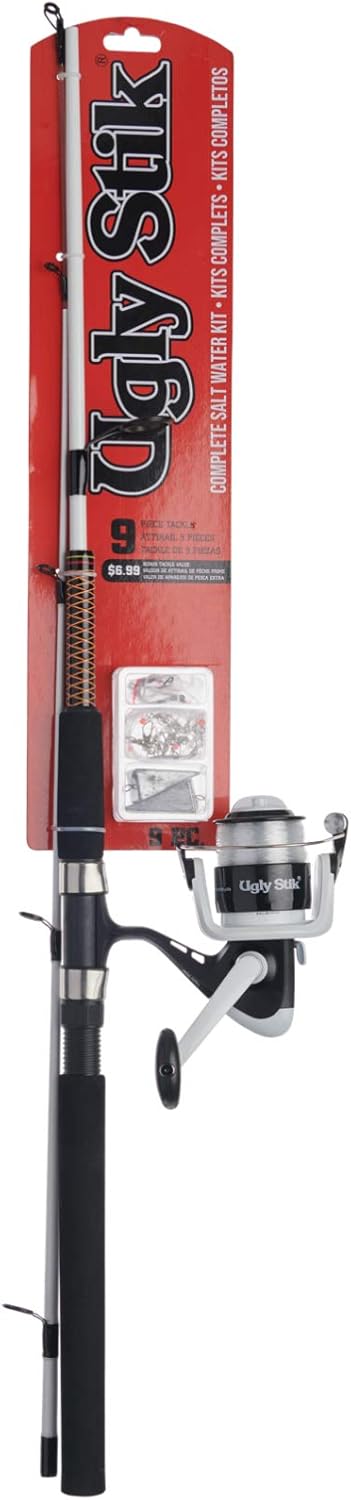
The value pick: Ugly Stik Complete Spincast Reel and Fishing Rod Kit
 Visit on Amazon →
Ugly Stik has been the value king in my shop for as long as I have had a shop. The blank takes a beating that would turn a graphite rod into a two piece rod the hard way, and the action is good enough for about 90 percent of the fishing most people actually do. Pond bass, panfish, a schoolie striper, a channel cat on a chunk of shrimp. That is the job.
The kit arrives as a matched package, rod and spincast reel built for each other, which matters more than people think. A mismatched combo is where a lot of first-timers get into trouble, because the reel is too heavy for the butt or too light for the tip and the whole rig feels dead in the hand.
Flaws but not dealbreakers: Ugly Stik blanks are not sensitive. You will not feel a soft take the way you would with a high modulus rod, and if you fish a finesse worm on a slack line, you will notice. For a beginner that is a feature, not a bug. A rod that forgives a bad hookset keeps people fishing.
This is the combo for a kid, a spouse, a grandparent, or anyone who wants one rod that works and does not want to think about it again.
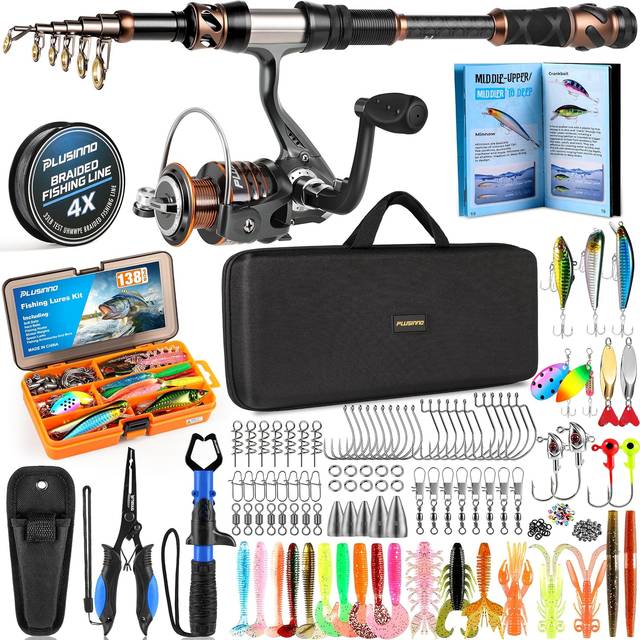
The travel pick: PLUSINNO Fishing Rod and Reel Combo with Telescopic Fishing Pole
 Visit on Amazon →
The PLUSINNO kit is the one I recommend when the rod has to live in a trunk, a backpack, or an overhead bin. The pole is telescopic, so it collapses down into a package that fits inside the carrier bag that ships with it, and the kit includes a tackle box and manuals, which is more than most starter combos bother to include.
The telescopic design is the whole point and also the thing you have to maintain. Every joint is a place where the rod can flex wrong if you do not seat it properly, and I cover that in the setup steps below, because it is the single most common mistake I see with travel rods.
Flaws but not dealbreakers: Telescopic rods are a compromise. You trade some backbone and some sensitivity for the ability to fit the rod in a bag. If you fish the same pond every weekend, buy the Ugly Stik. If you fish wherever you happen to be, the PLUSINNO is the one that actually makes it into the car.
Freshwater is where this kit is aimed, and that is where it belongs. Rinse it after saltwater and it will still work, but I would not plan a tarpon trip around it.
The actual setup workflow
Now the part you came for. This works on any closed face spincast combo.
Step one: Inspect before you spool. Run your fingernail around the inside of every guide. If you feel a nick or a groove, that guide will shred line and you will blame the fish. Check the reel seat by mounting the reel and trying to rock it side to side. Any wobble means the seat is not locking down, and you need to fix that before you fish, not after.
Step two: Load the line correctly. Pop the front cover off the reel. Tie an arbor knot around the spool, then run the line out through the pickup and out the hole in the nose cone. Fill the spool until the line sits just shy of the rim. Too little line and you lose casting distance. Too much and the line jumps off the front and tangles under the cover, which is the classic spincast bird nest.
Step three: Set the drag by feel. Pull line off the spool by hand. It should come off with steady resistance, not free spool and not locked up. For most freshwater fishing that is a drag you can pull with two fingers and a firm grip. If you have a scale, use it, but your hand will tell you the truth after a few pulls.
Step four: Check the spool tension and the anti-reverse. Reel the handle forward and listen. A healthy spincast reel is quiet and smooth. If you hear a grind, back the drag off and try again. Make sure the anti-reverse is engaged so the handle does not spin backward when a fish runs.
Step five: Rig it simple. For a beginner, a float, a split shot, and a small hook is the rig that catches the most fish and tangles the least. If you are chasing bass, a small jig or a plastic worm on a light hook is fine, but keep it light. Heavy lures are hard to cast on a spincast reel, and a heavy lure is the second most common cause of a tangle.
Step six: Set up a telescopic rod properly. Extend each section from the butt up, not from the tip down. Align every guide so it runs in a straight line down the rod. Seat each joint with a gentle quarter turn so the sections lock, then check the guides again. A misaligned guide on a telescopic rod will cut your distance in half and can put a set in the blank.
Step seven: Cast it right. Hold the button down with your thumb, bring the rod back to about two o'clock, and release the button when the rod passes forward. Not at the start of the forward motion, and not after the rod stops. If the line balloons and drops at your feet, you released late. If it shoots up, you released early.
The first hour on the water
Three things go wrong for every beginner, and all three are fixable in under a minute.
The line piles up at your feet. That is a release timing problem, covered above. Slow the cast down and release a hair earlier.
The line tangles under the nose cone. That is almost always too much line on the spool, or line that has taken a set from sitting coiled on a shelf. Strip off the top layer, or respool with fresh line.
The drag slips on the hookset. A spincast drag knob is easy to bump with your palm. Check it after you rig, and check it again after you land a fish.
What I am not covering here
Baitcasting reels, conventional saltwater rods, and fly gear are all better tools for specific jobs, and none of them belong in a beginner's first setup. A baitcaster will out-cast a spincast reel once you have the thumb for it, and a heavy conventional rod is the right tool for a big grouper, but both of those are second rods, not first ones. You learn to cast on a closed face reel, then you move up when you know what you actually want.
I also left out the high end graphite rods on purpose. If you have been fishing for twenty years and you want to spend real money, spend it. If you are buying your first rod, the extra money buys sensitivity you do not yet know how to use.
What this actually costs
Both combos above are entry level, and both are listed on Amazon at Check current Amazon price. Beyond the rod, budget for line, hooks, a few floats, and a license. That is the whole kit, and it is less than one guided trip.
The math I care about is cost per trip. A combo that gets used twenty weekends a year costs you very little per outing. A combo that sits in the garage because it tangles every third cast costs you the full price and the fish you did not catch.
The bottom line
Setup beats price. Load the line to the right level, set the drag so it gives without slipping, keep the guides aligned, and release the button on time. Do those four things and either of these combos will put fish in your hands.
Start with the Ugly Stik if you fish the same water every weekend. Start with the PLUSINNO if the rod has to travel. Then go fishing, because the rod is a tool and the fish is the review.