Most beginner setups don't fail on the first cast. They fail on the fourth trip, when the guides have started to groove, the reel seat has begun to rock, and the line has been sitting on the spool since spring. Learning how to choose a beginner fishing rod and reel combo comes down to four parts: the action, the guides, the reel seat, and how the drag behaves when a fish makes a run at the boat.
I guided out of Destin for 24 years, and I've watched more people lose fish to wobbling reel seats and dry drag washers than to bad casting. The rod is a tool. The fish is the review.
This guide covers what to look at before you buy, how to set the combo up once the box lands on your porch, and two setups that make sense depending on whether you want everything in one box or a rod you can grow into.
Why you should trust me
I ran charters out of Destin until my knees voted me off the deck. These days I own a tackle shop, I spool more line than most factories, and I keep a logbook of every rod's action curve: where it loads, where it stops loading, and what the mid-section does when a fish pulls the tip down and the backbone takes over.
Every rod that comes through my shop gets the same treatment. A full season of real fishing. A backbone test against a 40-pound drag setting. A casting test with two people, one who has never thrown a baitcaster in their life and one who has been doing it for 30 years, because a rod that only casts well in expert hands is a rod I won't hand to a paying client.
I don't publish a verdict on a rod until it has 20 trips on it. That rule is why you won't find a score at the bottom of this page. What you'll find is how I evaluate these setups and what to check the day the box arrives.
How I evaluate a rod, and where these two fit
Action is everything. Power ratings are marketing; how a rod loads and unloads is engineering. A blank stamped "medium" that folds into the middle on a quarter-ounce jig is not a medium rod in any useful sense. It's a moderate rod wearing a medium label, and if you bought it to throw light lures you'll feel every cast as mush.
The other three things I check before anything else:
- Guides. Cheap rings groove. A grooved guide shreds line and costs you fish. Run a cotton swab around the inside of every ring. If it snags fibers, send it back.
- Reel seat. Grab the reel and try to rock it side to side. Any wobble at the bench becomes a disaster on a 20-pound fish.
- Backbone. The mid-section is what turns a fish. Tip-only rods are fun right up until something with shoulders eats the bait.
That's the checklist. The two setups below sit at different points on the beginner curve. One is everything in a single box. The other is a rod you keep after you outgrow the box.
What to buy before your first cast
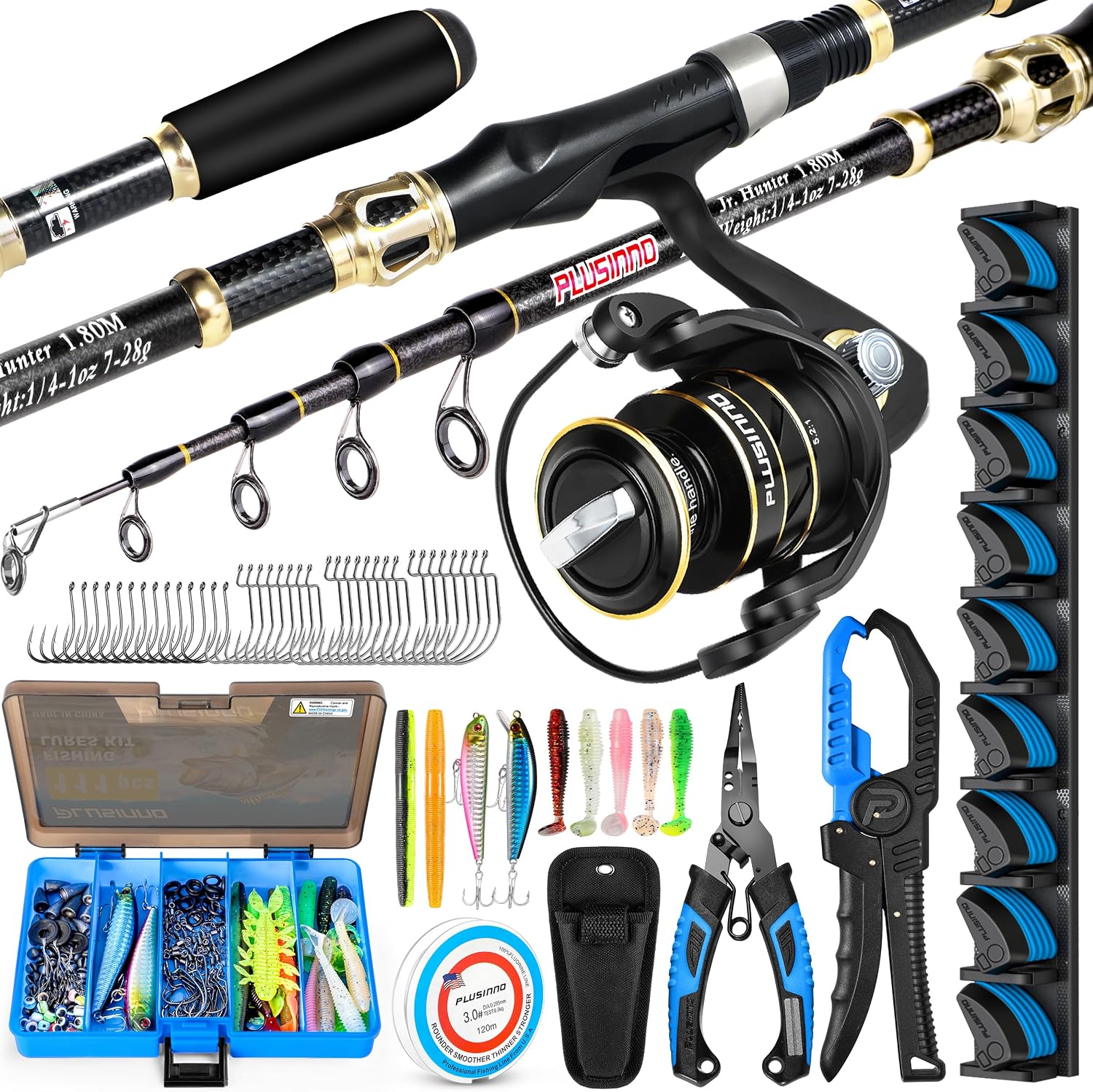
Complete starter kit: PLUSINNO Fishing Gear,Full Fishing Pole kit Include Fishing Rod and Reel Combo, Tackle Box with Fishing Lures, Fishing Accessories, Fishing Pliers,Fishing Gifts for Men with Fishing Tool Kit
 Visit on Amazon →
Check current Amazon price on the listing, since the number moves with the season. This is the box I point a brand new angler toward when they walk into my shop with no gear at all and a Saturday free. You get the rod, the reel, a tackle box with lures already sorted, pliers, and a small tool kit. That last part matters more than people expect, because most first-season frustration is a hook buried in a fish's mouth and no way to get it out.
The honest caveat with any all-in-one kit is that the line usually arrives with some age on it. Plan to strip it and respool before your first trip. That's a 15-minute job and it changes how the whole rig casts.
Flaws but not dealbreakers: An all-in-one kit is a starting point, not a finishing rod. Treat the first season as your classroom. Once you know whether you're a lure angler or a bait-and-wait angler, you'll know what to buy next, and you'll buy it once.
Anyone who wants one purchase that gets them fishing this weekend, with pliers and tackle already in the box, will be happy here.
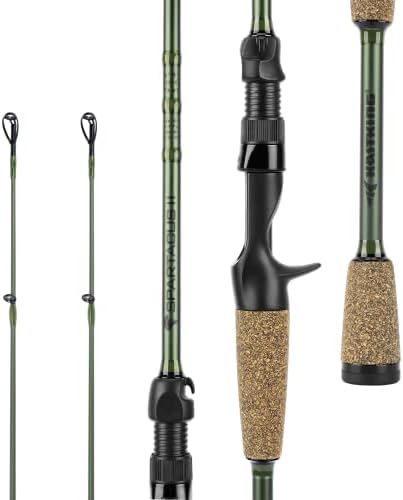
The rod to grow into: KastKing Spartacus II Twin-Tip Spinning & Casting Fishing Rods
 Visit on Amazon →
Check current Amazon price on the listing. The twin-tip design is the interesting part. Two tip sections on one blank means you get two different actions out of a single rod, which is exactly the kind of flexibility I want in a second rod. You can fish the softer tip when you're throwing light lures at spooky fish and switch to the stiffer tip when the wind picks up or you're dragging something heavier through the grass.
The line is offered in spinning and casting builds, so match it to the reel you already own rather than buying a reel to match a rod. If you've never thrown a baitcaster, take the spinning version. Level-wind backlash is a skill, not a personality trait, and learning it on a windy day is miserable.
Flaws but not dealbreakers: Twin-tip rods put the ferrule right where you don't want a weak point if you're careless seating the tip. Push it in firmly and check it before every trip. A tip that works loose mid-cast is a bad afternoon.
Anyone who has one season behind them and wants a rod that covers more than one technique should look here before they look at a $300 blank.
Match the rod to the fish you actually catch
Buy for the fish in your local water, not the fish on the catalog cover. This is the single mistake I see most in the shop.
- Inshore saltwater (redfish, speckled trout, flounder): a 7-foot medium or medium-light spinning rod with a fast action. It throws a quarter-ounce jig head far enough to reach the flat and still has the backbone to turn a fish away from a dock piling.
- Freshwater bass: 7-foot medium-heavy fast for jigs and Texas rigs, 7-foot medium for treble-hook baits like crankbaits and topwater. Treble hooks and stiff rods pull baits away from fish.
- Panfish and trout: 6-foot light or ultralight with a moderate action. Too fast and you rip the hook out of a soft mouth.
- Surf and pier: 9 to 10 feet, medium-heavy. You need length to clear the breakers, not power to winch a truck.
Then read the lure weight range printed on the blank and stay inside it. Match your lure to the rod, not the other way around. A rod rated for a quarter to three-quarters of an ounce will cast a half-ounce plug beautifully and lob an eighth-ounce jig like a wet sock.
The setup: from box to first cast
Step one: Inspect the blank. Run your thumb down the length of the rod looking for dings in the finish. Flex it gently. If you hear a creak, stop there.
Step two: Check every guide. Cotton swab, inside of every ring, including the tip top. This takes 60 seconds and it is the single best warranty test you can run.
Step three: Seat the reel. Slide the foot into the seat and tighten the nut firmly by hand, then try to rock the reel. No movement, no problem. Wobble means either the seat is bad or the reel foot is out of spec, and either way you want to know now.
Step four: Spool the line. For a first season, monofilament in the 8 to 12 pound class is the right call. It's forgiving, it's cheap to replace, and it doesn't punish a missed backlash the way braid does. Fill the spool to about an eighth of an inch from the lip. Underfilled spools cost you distance; overfilled spools throw loops.
Step five: Tie the right knot. Improved clinch for monofilament, Palomar for braid. Wet the knot before you cinch it down. A dry knot burns itself and fails at the worst moment.
Step six: Set the drag. Use a spring scale and set it to about a quarter of your line's breaking strength. Then leave it alone. Anglers who crank the drag down at the boat lose more fish than anglers who never touch it.
Step seven: Practice in the yard. Tie on a casting plug, not a hook. Ten minutes of yard casting teaches you more than an hour of untangling line on the water.
Step eight: Rinse and store. Freshwater rinse after every salt trip, dry the guides, back the drag off before the rod goes in the rack.
The maintenance that decides season two
A rod that gets rinsed lasts three times as long as one that doesn't. Salt sits in the guide frames and eats the finish first, then the ring. Rinse with fresh water, wipe down the blank, and put a drop of reel oil on the handle knob and the line roller once a month.
Replace your line once a year whether it looks fine or not. Line is the cheapest part of the whole system and the one that fails first.
What I'd skip
Skip the second rod until you know what you fish. Skip the giant tackle box that holds 400 lures you'll never tie on. Skip braid for your first month. Skip any rod sold without a printed lure weight range, because that tells you the maker didn't care enough to rate it. And skip the upgrade parts before the first season is over. A rod that costs $300 but needs $100 of upgrades is a $200 rod with good paint.
What this all costs
The kit and the twin-tip rod both sit in the beginner-to-second-rod range. Check current Amazon price on each listing, because these move with the season and with the sales calendar. The recurring cost is line, hooks, and a license, and the line is the only one of those you'll replace more than once a year.
The math that matters isn't the sticker. It's whether the rod you buy this month still gets fished three seasons from now. Buy the one that matches the water in front of you, set it up properly the day it arrives, and rinse it when you get home. That's the whole job.