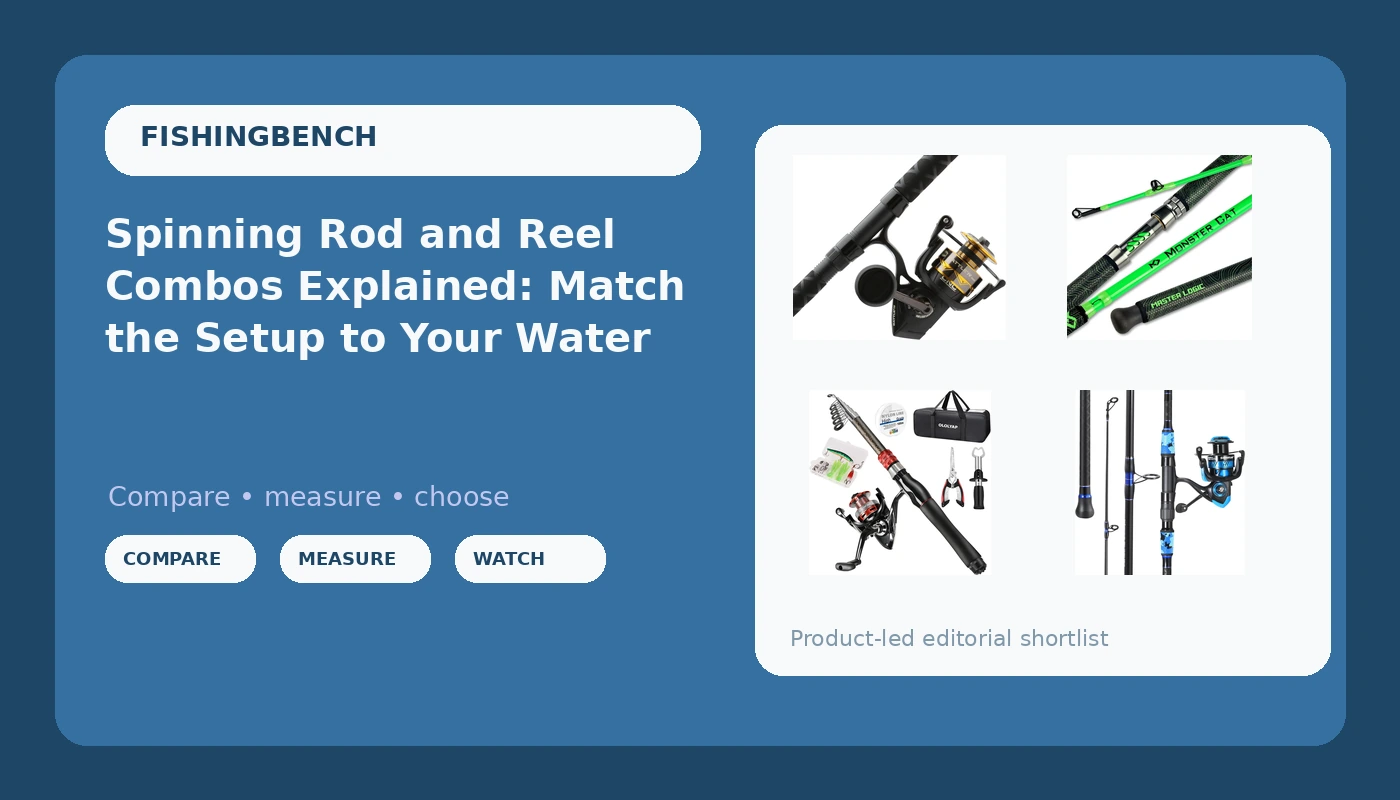
A spinning rod and reel combo is the shortest path from a box on the porch to a bait in the water. You do not have to match a blank to a reel foot, you do not have to learn which line class pairs with which guide train, and you do not have to burn a Saturday in a tackle shop doing it. The trade is that a combo locks you into one pairing, so that pairing has to be right for the water you actually fish.
That is the whole problem with shopping for a spinning rod and reel combo. Four packages can carry nearly identical language on the label and still be built for completely different jobs: an open surf beach, a catfish river, an inshore flat, or the back of a car. Below, four current options are broken down by the job each one is shaped for, followed by the specs that decide whether any combo works for you.
Related: Rod Action and Power: How the Blank Changes Your Cast →
Quick answer
For mixed inshore and general saltwater duty, the Penn Battle IV Spinning Reel and Fishing Rod Combo is the most broadly useful pairing in this group because the rod and reel arrive matched. For open surf fished from the sand, the Sougayilang Surf Fishing Rod and Reel Combo is built around that job, with a 4-piece MH/H blank and a 5000 size spinning reel offered in 12-foot and 15-foot lengths. If catfish are the target and you already own a reel, the Monster Catfish Casting Rod is a 7-foot, one-piece, glow-in-the-dark casting rod sold as a rod only. If you want the lowest-cost way to put a rod, a reel, and a couple of handling tools in one box, the Fishing Pole Combo Set 6.9ft Telescopic kit covers it.
Four useful options
| Model | Best fit | What stands out |
|---|---|---|
| Penn Battle IV Spinning Reel and Fishing Rod Combo | All-around inshore and mixed saltwater | A matched Penn spinning reel and rod sold as one package |
| Sougayilang Surf Fishing Rod and Reel Combo | Beach and open surf | 4-piece MH/H blank with a 5000 size spinning reel, offered in 12' and 15' |
| Monster Catfish Casting Rod | Catfish and heavy bait duty | 7-foot one-piece MH casting rod with a glow-in-the-dark finish |
| Fishing Pole Combo Set 6.9ft Telescopic | Travel, beginners, and spare setups | Telescopic 6.9-foot rod and reel plus pliers and a lip gripper |
The all-around saltwater pick: Penn Battle IV Spinning Reel and Fishing Rod Combo
The value of a matched combo is not the discount, it is the elimination of a whole category of mistakes. A reel that does not sit flat in the seat will rock under load, and a rocking reel on a fish that is still green is how rod butts get broken. When the manufacturer pairs the two, that variable is off the table. The trade-off is flexibility: you cannot swap in a different reel size for a different season without the pairing changing too. For an angler who wants one rod that handles slot reds, trout, flounder, and the occasional run of something bigger, that is a reasonable trade. Read the listing to confirm which length and power variation you are selecting, because combo listings often bundle several.
The surf setup: Sougayilang Surf Fishing Rod and Reel Combo
Surf rods live a harder life than most. They get laid on sand, splashed with salt, and cast with weight that would snap a freshwater blank. Two things on this combo stand out for that environment. First, the 4-piece layout means a 12 or 15 foot rod travels in a bag instead of riding across your back seat, which matters if you drive to the beach. Second, the MH and H power options tell you this blank is rated for payload, which is what you want when you are throwing sinkers and bait rather than small plugs. The honest trade-off is ferrule count: every joint is a place where the bend is no longer continuous, and every joint needs to stay clean and fully seated. A four-piece rod is a compromise in the name of portability, and it is a good compromise if portability is what you need.
The dedicated catfish rod: Monster Catfish Casting Rod
This is the one entry in the group that is a rod only, so budget for a reel and line separately. What you get for that is a blank with no ferrules in it. A one-piece rod is the strongest and most predictable layout you can buy, because the bend runs uninterrupted from butt to tip and there is nothing to work loose after a hundred casts. The 7-foot length is short enough to fish from a bank or a boat deck without clipping every tree behind you, and the MH power suits the kind of weight and bait that catfish anglers throw. The glow-in-the-dark finish is a practical detail rather than a gimmick: catfish bite after dark, and a rod you can locate with a flashlight sweep is a rod you are less likely to leave on the bank. The cost is transport. A one-piece 7-footer does not fold, so measure your vehicle before you commit.
The travel and starter kit: Fishing Pole Combo Set 6.9ft Telescopic
Telescopic rods are the most portable design on the market and the one with the most moving parts. The blank slides into its own handle, which means the rod can live in a backpack, a suitcase, or a glovebox, and that is a real advantage for anyone who fishes on trips rather than on a schedule. The trade-off is that telescopic sections introduce more joints and more places for grit to collect, so they reward a quick rinse and dry after every saltwater outing. The included pliers and lip gripper are worth noting because most entry combos stop at the rod and reel. If you are outfitting a kid, a guest, or a kayak where gear gets lost, having the handling tools in the same box removes a second purchase.
Prices and availability may change. Product images, names, and retailer links are matched to verified listings. No current price, rating, stock status, or measured result is stated here without current evidence.
Action and power are two different specs
These two words get glued together on rod labels, and they do not mean the same thing. Action describes where the blank bends. A fast action bends mostly in the top third, a moderate action bends through the middle, and a slow action bends deep toward the butt. Power describes how much force it takes to bend the blank at all, and that is what the letters MH and H refer to: medium heavy and heavy. A medium heavy rod is not simply a faster heavy rod. It is a separate measurement, and it is the one that tells you what weight the blank is built to move.
Why this matters when you are comparing a spinning rod and reel combo: a fast, medium heavy rod gives you a quick tip for working a lure and a stiffer mid-section for driving a hook home. A moderate action loads deeper into the blank, which helps when you are casting weight and bait instead of snapping a lure, and it gives line a softer cushion when a fish runs. Neither is superior. They are matched to techniques, and a rod rated for the wrong technique will feel wrong no matter what it cost.
One more thing worth knowing: power ratings do not travel cleanly between brands. A medium heavy from one maker can fish like a heavy from another. Treat the label as a starting point and read the line and lure ratings on the specific listing you are buying.
Piece count, portability, and what you give up
Every joint in a rod is a place where the blank stops being one continuous piece of material. A one-piece rod has none of them, which is why a single-piece casting rod is the most predictable layout and the least convenient to move. A four-piece rod packs small but adds three ferrules that have to stay clean and fully seated. A telescopic rod collapses into its own handle, which is the most portable layout and the one with the most components to maintain. There is no free option here, only a trade you choose on purpose.
- Name the water you fish most, then buy for that water. A surf combo and a bank catfish rod are not interchangeable.
- Match power to the weight you cast. Heavy sinkers and bait ask for MH or H; small lures do not.
- Match action to how you fish. Fast for working lures, moderate for casting weight and letting it sit.
- Decide whether you need a reel in the box. Two of these packages include one; one is a rod only.
- Check the layout against your vehicle, your storage, and your travel. A one-piece 7-footer needs room.
Practical guidance before you buy
- Read the label as two separate specs, action and power, and check both against your target species.
- Confirm whether the listing is a combo or a rod only, and whether reel and line are included.
- Match reel size to rod length and line class; a long surf blank and a 5000 size reel are paired for a reason.
- Plan for salt. Rinse guides, seats, and ferrules after every trip, because salt does not leave on its own.
- Buy for the fish you actually catch, not the fish in the catalog photo.
Which option should you choose?
Choose the Penn Battle IV Spinning Reel and Fishing Rod Combo when you want one matched saltwater package for mixed inshore fishing and you would rather not think about pairing a reel to a blank. Choose the Sougayilang Surf Fishing Rod and Reel Combo when you fish open beach and need distance, payload capacity, and a rod that breaks down for the drive. Choose the Monster Catfish Casting Rod when catfish are the target, you already own a suitable reel, and you want a one-piece blank with a finish you can find after dark. Choose the Fishing Pole Combo Set 6.9ft Telescopic when portability or a complete starter kit matters more than a specialized blank.
A caveat worth stating plainly: action and power ratings are manufacturer language, not universal standards, and a combo listing often bundles several length and power variations under one page. Verify the exact configuration, line rating, and included components on the listing before you buy. Nothing here substitutes for reading the specs for the specific variation you select.
The bottom line
A spinning rod and reel combo is a convenience purchase, and convenience is worth paying for only when the pairing matches your water. The Penn Battle IV combo suits an angler who wants one matched inshore setup. The Sougayilang surf combo suits the beach angler who needs length and portability. The Monster Catfish Casting Rod suits the bank angler who wants a single-purpose one-piece blank. The telescopic kit suits travel, beginners, and spare setups. Pick the job first, then pick the rod.