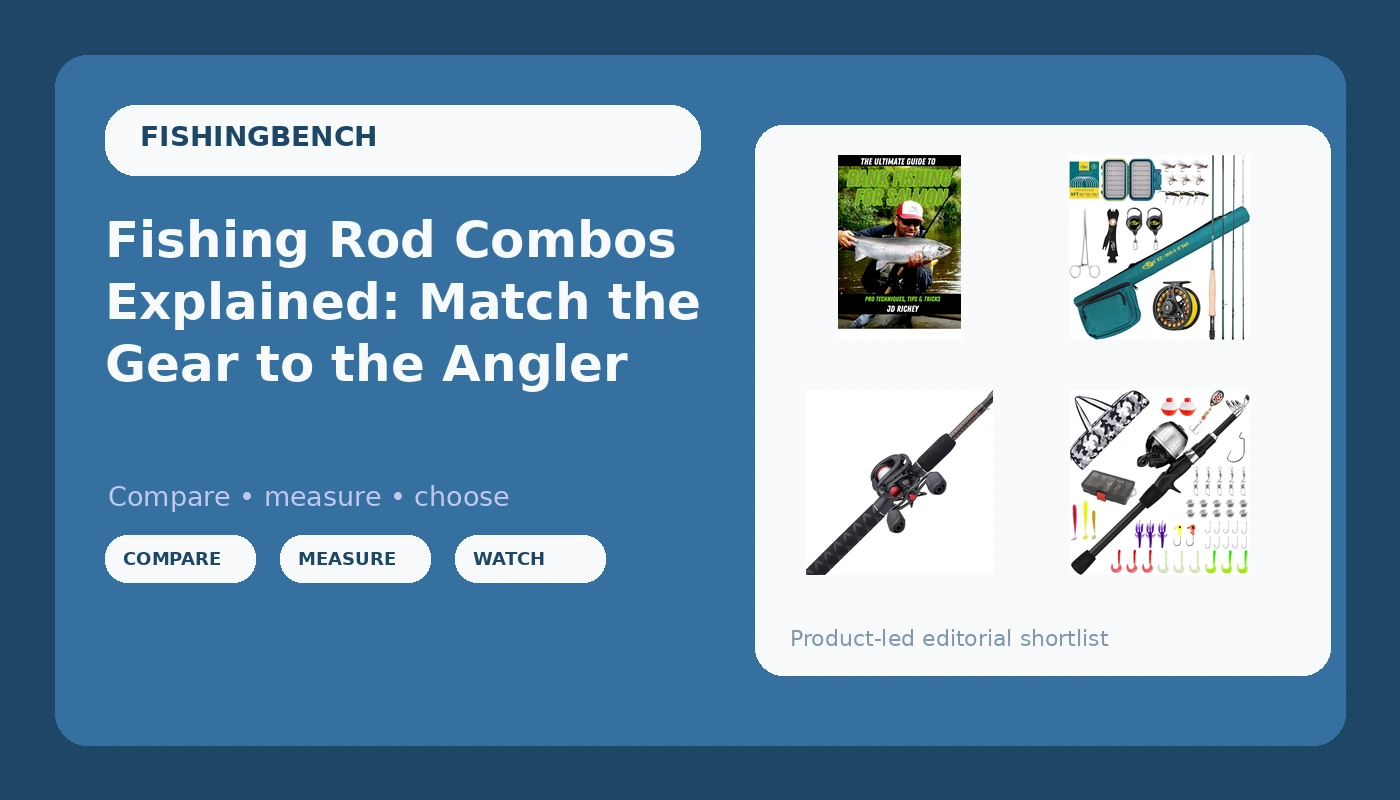
Fishing rod combos exist to solve the most annoying part of getting started, which is matching a rod to a reel without guessing at balance, reel seat size, or line capacity. The trouble is that "combo" covers a kid's first pole, a fly kit that ships with a tapered leader, and a baitcast setup built for casting accuracy, and those three things have almost nothing in common. Buy the wrong one and you end up with a rod that loads wrong for the fish you actually catch, or a reel that fights you on every cast. This explainer walks through what fishing rod combos really are, which parts determine whether one is worth owning, and how four current options line up against different anglers and different water.
Related: How to Choose a Spinning Rod for Inshore Saltwater →
Quick answer
A fishing rod combo is a rod and a reel sold together as a matched pair, sometimes pre-spooled and sometimes ready for line of your choosing. The right one comes down to three things: the species you target, the water you fish, and how you cast. For an angler who wants one baitcast setup to cover a wide range of freshwater and light saltwater situations, the Ugly Stik GX2 Low Profile Baitcast Reel and Fishing Rod Combo is the general-purpose pick here. For fly fishing, the SF Fly Fishing Rod Combo Starter Kit is built around trout and travel. For a child, the WIDDEN Kids Fishing Pole Set is sized and kitted for youth. And if your plan is to fish from shore for salmon, the Ultimate Guide to Bank Fishing for Salmon teaches the approach before you spend anything on tackle.
Four useful options
| Model | Best fit | What stands out |
|---|---|---|
| Ugly Stik GX2 Low Profile Baitcast Reel and Fishing Rod Combo | One baitcast setup for general use | Rod and low-profile baitcast reel sold as a matched combo |
| SF Fly Fishing Rod Combo Starter Kit Semi Gloss Green Jade Finish 24T Carbon Fiber Trout Travel Fly Rod with Reel,Fly Rod case,Fly Box , Flies,Tapered Leader,Knot Tying Tools | Trout and travel fly fishing | 24T carbon fiber rod packaged with reel, rod case, fly box, flies, tapered leader, and knot tying tools |
| WIDDEN Kids Fishing Pole Set with Full Starter Kits for Youth Boys Girls | Young beginners | A pole set bundled with full starter kit components |
| Ultimate Guide to Bank Fishing for Salmon (Fishing How-To) | Learning shore-based salmon fishing | A how-to book focused specifically on bank fishing for salmon |
The general-purpose pick: Ugly Stik GX2 Low Profile Baitcast Reel and Fishing Rod Combo
The trade-off with a baitcast combo is the reel itself. Baitcast reels put the spool under your thumb, which means the line only stops when you stop it. That gives you casting accuracy that spinning gear cannot match, and it also gives you backlashes while you are learning. If you have never cast one, budget a few sessions on open water with a heavier lure before you take it anywhere with structure. What you get in return is a setup where the rod and reel were designed around each other, so the reel seat, the guide layout, and the balance point are already settled. That is the real argument for buying a combo instead of assembling one.
The fly fishing starter: SF Fly Fishing Rod Combo Starter Kit Semi Gloss Green Jade Finish 24T Carbon Fiber Trout Travel Fly Rod with Reel,Fly Rod case,Fly Box , Flies,Tapered Leader,Knot Tying Tools
Fly fishing is the one category where a combo makes the most sense, because the line is the weight you cast, not the lure. The tapered leader in this kit matters more than beginners expect: it is the transition between a thick fly line and a thin tippet, and getting it wrong is why so many first fly casts land in a pile. The accessories here, the flies, the box, the knot tools, are the small purchases that add up fast when you buy them separately. The caveat is that a travel rod breaks down into multiple pieces, which is convenient for packing but adds a ferrule connection you need to keep clean and seated. None of that replaces practice. A fly rod rewards a smooth stroke and punishes a hard one, and no kit changes that.
The youth setup: WIDDEN Kids Fishing Pole Set with Full Starter Kits for Youth Boys Girls
The honest trade-off with any kids' set is that the tackle in the box is the part that disappears. Small hooks, bobbers, and split shot go into grass, pockets, and the bottom of the boat, and you will replace them. That is fine. The point of a youth set is not durability or performance, it is getting a child to the water with gear that fits their hands and does not require an adult to re-rig every thirty seconds. Pair it with bluegill, perch, or whatever small fish are plentiful near you, keep the sessions short, and let the catching do the persuading. If the kid is hooked after a season, that is when you buy the next rod up.
The reference: Ultimate Guide to Bank Fishing for Salmon (Fishing How-To)
This is the odd one out in a list of combos, and it earns its place. Bank fishing for salmon is a specific discipline: you are reading current seams, timing runs, and figuring out where fish hold within casting distance of shore. Those are decisions no rod makes for you. Reading up first also protects your wallet, because shore salmon fishing pushes tackle in ways a general freshwater combo does not, and knowing what you actually need keeps you from buying the wrong thing twice.
Prices and availability may change. Product images, names, and retailer links must be matched by verified ASIN. Do not state a current price, rating, stock status, or measured result without current evidence.
How rod action and power actually work
Action describes where a rod bends. A fast action rod bends mostly in the top third, a moderate action bends through the middle, and a slow action bends deep into the butt. Power is a separate rating and describes how much force it takes to bend the rod at all. Manufacturers market power aggressively because it sounds like strength, but action is the spec that changes your day. A fast rod loads quickly and gives you a crisp, accurate cast with a tight loop. A moderate rod loads more gradually and is more forgiving of an imperfect stroke, which is why it suits treble-hook lures and beginners. A slow rod bends deep and feels soft on the cast but absorbs a lot of shock when a fish surges.
The practical consequence is that a combo rated "medium heavy, fast" and a combo rated "medium, moderate" can both be called all-purpose and behave nothing alike. If you cast light lures, a stiff fast rod will not load, and you will feel like you are casting with a broomstick. If you throw heavy lures into cover, a soft moderate rod will fold over and leave you without the backbone to move a fish away from structure. Match the action to the weight range you actually throw, not to the biggest fish you hope to catch.
The parts that fail first: guides and reel seats
Two components decide whether a rod survives a season. Guides route the line, and cheap ones groove. Once a guide develops a groove or a rough edge, it shreds line, and a shredded line is a lost fish and a wasted spool. Run a cotton swab around the inside of every guide before you fish a new rod. If it catches fibers, the guide is not finished properly. Line guides on a saltwater rod also need to resist corrosion, and a rod marketed as saltwater ready that shows rust at the guide feet after a few trips was not.
Reel seats are the other failure point. A reel seat that does not clamp the reel foot solidly will wobble under load, and wobble on a decent fish is how reels come loose mid-fight. Check it by mounting the reel and trying to twist it side to side with your hand. Any movement there is a problem you cannot fix later.
A five-step way to pick a combo
- Name the species you will target most often, not the one you daydream about. Gear follows the fish you actually catch.
- Match the water. Ponds and small lakes reward lighter, shorter rods. Surf, jetties, and big rivers call for more length and more backbone.
- Decide your casting style. If you want accuracy and are willing to learn thumb control, a baitcast combo fits. If you want simplicity, spinning wins. If the line is the weight, you want a fly rod.
- Inspect the components before you commit: guides, reel seat, handle material, and how the rod balances with the reel mounted.
- Set the budget last. A combo that matches your water and your casting style is worth more than a more expensive one that does not.
Practical guidance for buying a combo
- Handle the rod with the reel mounted if you can. Balance point matters more than total weight.
- Check that the line rating printed on the rod overlaps the line you plan to spool.
- Buy the reel you want once. Upgrading a combo reel later usually costs more than buying the right combo first.
- Keep a spare spool of line and a spare leader. Line is the cheapest insurance in fishing.
- If you are buying for a child, prioritize fit and simplicity over specs. A rod that is too long is a rod they will not want to carry.
- Read before you buy when the technique is unfamiliar. Bank salmon fishing, fly casting, and baitcast thumb control all have learning curves that gear alone does not flatten.
Which option should you choose?
Choose the Ugly Stik GX2 Low Profile Baitcast Reel and Fishing Rod Combo when you want a single matched baitcast setup and you are willing to put in the practice that a baitcast reel requires. Choose the SF Fly Fishing Rod Combo Starter Kit Semi Gloss Green Jade Finish 24T Carbon Fiber Trout Travel Fly Rod with Reel,Fly Rod case,Fly Box , Flies,Tapered Leader,Knot Tying Tools when your target is trout and you want a fly setup that packs down and arrives with the accessories already in the box. Choose the WIDDEN Kids Fishing Pole Set with Full Starter Kits for Youth Boys Girls when you are introducing a child to fishing and want the decision to be about the experience, not the equipment. Choose the Ultimate Guide to Bank Fishing for Salmon (Fishing How-To) when salmon from shore is the goal and you want to understand the water and the technique before you commit to gear.
One caveat applies across all four: none of these is a substitute for local knowledge. Water conditions, regulations, and what the fish are actually eating change by region and by week, and a tackle shop or a local angler will beat a catalog every time on that question.
The bottom line
A fishing rod combo is a convenience purchase, and convenience is worth paying for only when the rod and reel genuinely suit the fishing you do. Decide on species, water, and casting style first, then let those three answers narrow the field. The Ugly Stik GX2 combo covers general baitcast work, the SF fly kit covers trout and travel, the WIDDEN set covers young beginners, and the bank fishing guide covers the homework that no rod can do for you. Get the fit right and the price becomes a much smaller part of the decision.