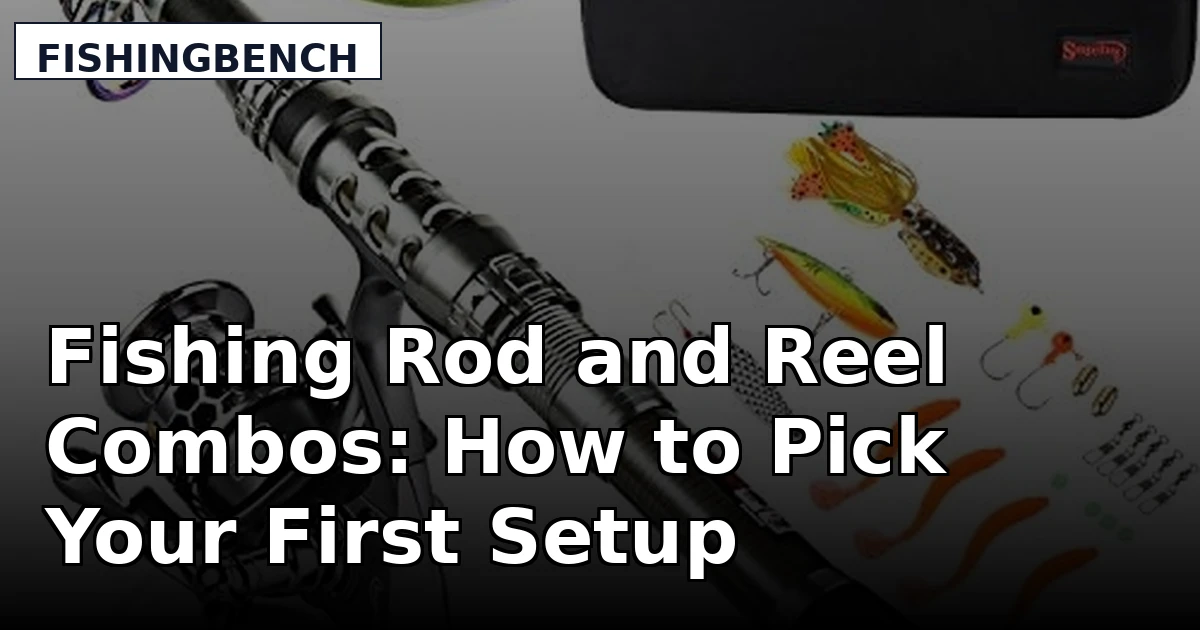
A first fishing rod and reel combo is a bundle decision, and bundles hide things. The rod's action, the guides, the reel seat, and the reel itself all get compressed into one box, and the listing copy rarely tells you which part got the money. That is the problem with shopping for fishing rod and reel combos: they look interchangeable in a photo, and they are not.
I spent 24 years running charters out of Destin before my knees pushed me behind the counter of a tackle shop, and the same questions come through the door every week. How long should the rod be? Spinning or casting? Does a telescopic rod actually hold up? The four options below cover the common entry points, and the sections after them explain the specs that decide whether a setup lasts a season or a decade.
Related: Rod Action and Power Ratings Explained →
Quick answer
Match the setup to the water you fish most, not to the biggest fish you hope to catch. For most freshwater beginners, a spinning rod in the 6 to 7 foot range with a medium power rating covers the widest range of species and techniques, and it is the easiest configuration to cast accurately. Choose a telescopic or backpack kit when portability is the priority, and choose a rod-only purchase when you already know which reel you want. Rod length, power, and guide quality matter more than the number of pieces in the box.
Four useful options
| Model | Best fit | What stands out |
|---|---|---|
| PLUSINNO Fishing Backpack with Rod & Reel Combos, Fishing Gear Kit | Anglers who want one bag to carry everything | Backpack format bundled with rod and reel combos plus a gear kit |
| Ugly Stik GX2 Casting Fishing Rod | Casting reel users buying a rod on its own | A casting rod sold without a reel, so you choose the match |
| Fishing Pole Combo, 6.9ft 2Pcs Telescopic Rods Set, Collapsible Carbon Fiber Fishing Rods, 2PCS Spinning Reel Set with Carrier Bag | Two anglers fishing freshwater together | Two telescopic rods and two spinning reels in one kit with a carrier bag |
| Sougayilang Fishing Rod Reel Combo with Telescopic Fishing Pole Spinning Reel Carrier Bag | Travel and mixed saltwater or freshwater trips | Telescopic spinning combo with a carrier bag, listed for saltwater and freshwater |
The all-in-one kit: PLUSINNO Fishing Backpack with Rod & Reel Combos, Fishing Gear Kit
The trade-off with any kit is that the money gets spread across more items. A backpack, a rod, a reel, and a box of tackle at one price means each individual piece is built to a budget. That is not a flaw, it is a design choice, and it is the right one if your problem is logistics rather than performance. If you fish from a kayak, walk a mile of bank, or ride a bike to a neighborhood pond, the value of a single bag you can grab and go is real, and it will get you on the water more often than a better rod that stays in the garage.
The rod-only pick: Ugly Stik GX2 Casting Fishing Rod
Here is where I part company with a lot of starter advice. A combo forces the manufacturer to match a rod and a reel for you, and at entry price points that match is often the weakest part of the package. Buying a rod alone lets you spend your budget where it counts and add a reel you chose. The catch is that a casting rod is not a spinning rod. Casting gear asks more of your thumb and your timing, and a beginner who has never thumbed a spool will backlash a casting reel repeatedly on the first trip. If you are new to baitcasting, that learning curve is the trade-off you are accepting, and it is worth accepting only if you actually want to fish that style.
The two-rod starter set: Fishing Pole Combo, 6.9ft 2Pcs Telescopic Rods Set
Two rods at a low combined price solves a specific problem: the friend, the kid, or the spouse who wants to come along. Nothing kills a fishing trip faster than one rod and two people. Telescopic blanks trade a little sensitivity for portability, because every joint in a rod is a place where the load transfers differently than it does through a single continuous blank. For panfish, stocked trout, and pond bass, that trade is usually invisible. For finesse presentations where you need to feel a soft take, a one-piece or two-piece rod still reads better in the hand. Note that this kit is positioned for freshwater, so keep it out of the salt.
The travel combo: Sougayilang Fishing Rod Reel Combo with Telescopic Fishing Pole Spinning Reel Carrier Bag
Saltwater is where budget combos get exposed, and it has nothing to do with the rod's strength. It is the hardware. Salt spray and saltwater rinse find every guide frame, every reel seat hood, and every exposed screw, and a rod that was never built with corrosion in mind will show rust and pitting long before it breaks. If you plan to fish the surf or a pier, rinse the rod and reel with fresh water after every trip, dry the guides, and back the drag off before storage. The "saltwater ready" label on a listing is a claim, not a test result, so treat it as a starting point and inspect the hardware yourself.
Prices and availability may change. Product images, names, and retailer links must be matched by verified ASIN. Do not state a current price, rating, stock status, or measured result without current evidence.
Action and backbone: the two specs that decide everything
Action describes where a rod bends. A fast action bends mostly in the top third, a moderate action bends through the middle, and a slow action bends deep into the butt section. That single characteristic controls how the rod loads on a cast, how quickly it recovers, and how much of a fish's headshake gets absorbed before it reaches your line. A fast rod casts accurately and hooks fish with less effort. A moderate rod feels softer on the cast, keeps treble-hooked fish pinned better, and is more forgiving of a sloppy hookset.
Backbone is the rod's power through the midsection, and it is the number that tells you what the rod can actually fight. A rod can have a fast tip and heavy backbone at the same time, which is why "fast" and "heavy" describe different things. Marketing copy tends to blur the two, and a power rating that does not match the actual bend is one of the most common ways a budget rod disappoints. The honest test is simple: load the rod against a steady pull and watch where the curve starts. If the bend begins in the handle when the label says medium, the label is optimistic.
Guides, reel seats, and the parts that fail first
Guides route your line, and they take more abuse than any other component. Cheap guide rings groove under braided line and a grooved ring will shred a monofilament leader in a single cast. Run a cotton swab around the inside of each ring. If it catches fibers, that ring is already damaged and it will cost you fish. Guide frames matter just as much in salt, where plated frames pit and flake.
The reel seat is the other failure point, and it fails quietly. A seat that lets the reel rock even slightly under load will flex the foot of the reel every time you fight a fish, and that flex eventually works the screws loose. Check the seat by mounting a reel and twisting it firmly in your hand before you ever spool up. A wobble there is a hard no, because you cannot fix it later on the water.
- Decide where you fish most: pond, river, pier, or surf, and how far you have to carry your gear.
- Pick the reel type first. Spinning is easier to learn and more forgiving in wind. Casting rewards practice and accuracy.
- Match the power rating to your target species rather than the largest fish in the lake.
- Inspect the guides and reel seat in person or through close-up photos before you commit.
- Budget for line and terminal tackle, because a combo price never includes the line you actually want to fish.
Practical guidance for your first season
- Spool fresh line before the first trip. Old line on a new reel is the most common reason beginners lose fish.
- Set your drag by pulling line off the spool by hand. It should give steadily, not jerk or lock.
- Keep the rod tip up and let the backbone do the work. High-sticking a rod past 45 degrees is how blanks snap.
- Rinse everything with fresh water after saltwater trips, and back the drag off before the rod goes in the closet.
- Carry a spare spool or a second rod if you are fishing with a partner. One rod for two people ends the trip early.
Which option should you choose?
Choose the PLUSINNO Fishing Backpack with Rod & Reel Combos, Fishing Gear Kit when you want to carry everything in one load and you value convenience over individual component quality. Choose the Ugly Stik GX2 Casting Fishing Rod when you already fish casting gear or you want to choose your own reel and keep the rod as the foundation of the setup. Choose the Fishing Pole Combo, 6.9ft 2Pcs Telescopic Rods Set when two people are fishing freshwater together and you need two complete spinning setups. Choose the Sougayilang Fishing Rod Reel Combo with Telescopic Fishing Pole Spinning Reel Carrier Bag when portability and travel matter and you want a combo listed for both saltwater and freshwater.
None of these are claims about measured performance. Telescopic rods are a compromise on sensitivity, kit combos spread the budget across more items, and a casting rod asks for a skill a brand new angler has not built yet. Match the compromise to your situation instead of looking for the option with no compromise, because that one does not exist at any price.
The bottom line
Buy for the fish you actually catch. A medium power spinning rod in the 6 to 7 foot range will handle most freshwater species, a two-rod kit keeps a partner fishing, and a telescopic combo earns its place when the gear has to fit in a backpack or a suitcase. Check the guides and the reel seat before anything else, spool fresh line, and rinse the hardware after every saltwater trip. A rod that matches your water and survives a full season beats a better rod that sits in the garage. Check current Amazon price on any of the four and compare them against the water you fish most.