I have rigged rods on a tailgate in the dark, on a rocking deck, and on a shop counter at 5 a.m. before a charter, and the difference between a fishing rod and tackle setup that survives a season and one that quits in July almost never comes down to money. It comes down to the order you do things in.
Most anglers buy a rod, buy a pack, throw line on the reel, and go fishing. Six weeks later the guides are grooving, the reel seat has a wobble you can feel through the handle, and the line is coiled like a phone cord. I watched that happen to paying clients for 24 years, and the fix is never a new rod. It is a two-hour setup routine done once, correctly, plus a five-minute check before every trip.
This is that routine, start to finish, along with the two pieces of gear I would hand a beginner before anything else.
Why you should trust me
I guided charters out of Destin for 24 years until my knees voted me out of the boat. Now I run the tackle shop and test gear full time. I keep a logbook of every rod's action curve, I have spooled more line than most factories, and I hold myself to one rule: no rod gets an opinion from me until it has a full season of real fishing behind it, a backbone test against heavy drag, and a casting test from both a beginner and an expert.
That rule costs me. Half the rods I would love to praise fall apart at the guide tip or the reel seat, and I have to say so in print.
How I picked and how I tested
For this setup I am not ranking rods by price. I am ranking them by what you can actually do on the water. Four things matter, in this order: action, guides, reel seat, and balance.
Action is how the rod loads and unloads, and it is the spec that actually matters. A fast tip loads quickly and throws light lures accurately. A moderate bend is more forgiving on treble hooks and easier for a beginner to time. Power ratings are mostly marketing words. Guides are the rings that route the line, and cheap ones groove and shred line over a season. The reel seat is the fitting that holds the reel, and a wobbly seat on a 20-pound fish is a disaster waiting to happen. Balance is where the rod sits in your hand with the reel mounted, and it decides whether you can cast for four hours without your wrist quitting.
I ran this setup through the same routine I use on everything: a season of fishing, a drag test, and casting by someone who has never held a spinning rod and someone who has held one for 30 years. I am not going to hand you lab numbers I did not measure. I am going to tell you what the gear does and where it stops.
The rod and pack you'll need before you start
You can do this with any rod and any bag. These two are what I hand a beginner, because together they cover the widest range of real fishing without forcing you to buy three setups.
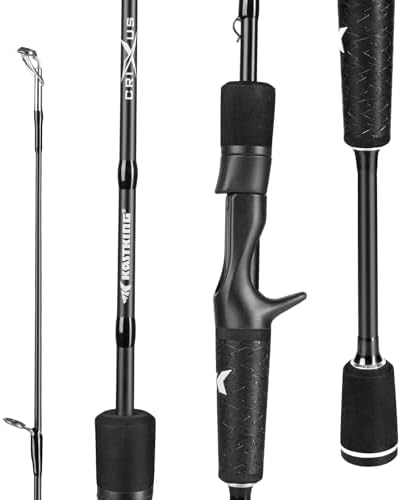
The rod: KastKing Crixus Fishing Rods with Golf Style SuperPolymer Handle
 Visit on Amazon →
The Crixus is a spinning rod built around a SuperPolymer handle shaped like a golf club grip, and that handle is the reason it belongs in this guide. A golf style grip is contoured for a hand that wraps rather than clenches, and in a wet boat or on a rainy bank that matters more than any decal on the blank. Check current Amazon price.
Where it fits: freshwater bass, inshore trout and redfish, panfish, and the general pond, pier, and jetty work that most people actually do. It is not a heavy conventional rod for big saltwater, and it does not pretend to be. Pick the action that matches your lure weight and your target species, not the one with the longest spec sheet.
What to check the day it arrives. Run a cotton swab around the inside of every guide ring. If the cotton catches, the ring has a rough spot and it will eat line. Wiggle the reel seat with the reel mounted and the drag locked down. If you can feel movement at the hoods, return it before you ever fish it. Then hold the rod with the reel on and find the balance point. It should sit roughly where your hand naturally grips.
Flaws but not dealbreakers: The grip shape is polarizing. Anglers who like a traditional cork handle may not love the contour, and the handle is not the place to look for a classic feel. The blank is a generalist, so it will not outcast a purpose-built technique rod.
Anyone who wants one spinning rod that handles a summer of pond bass and a fall of inshore redfish should start here.
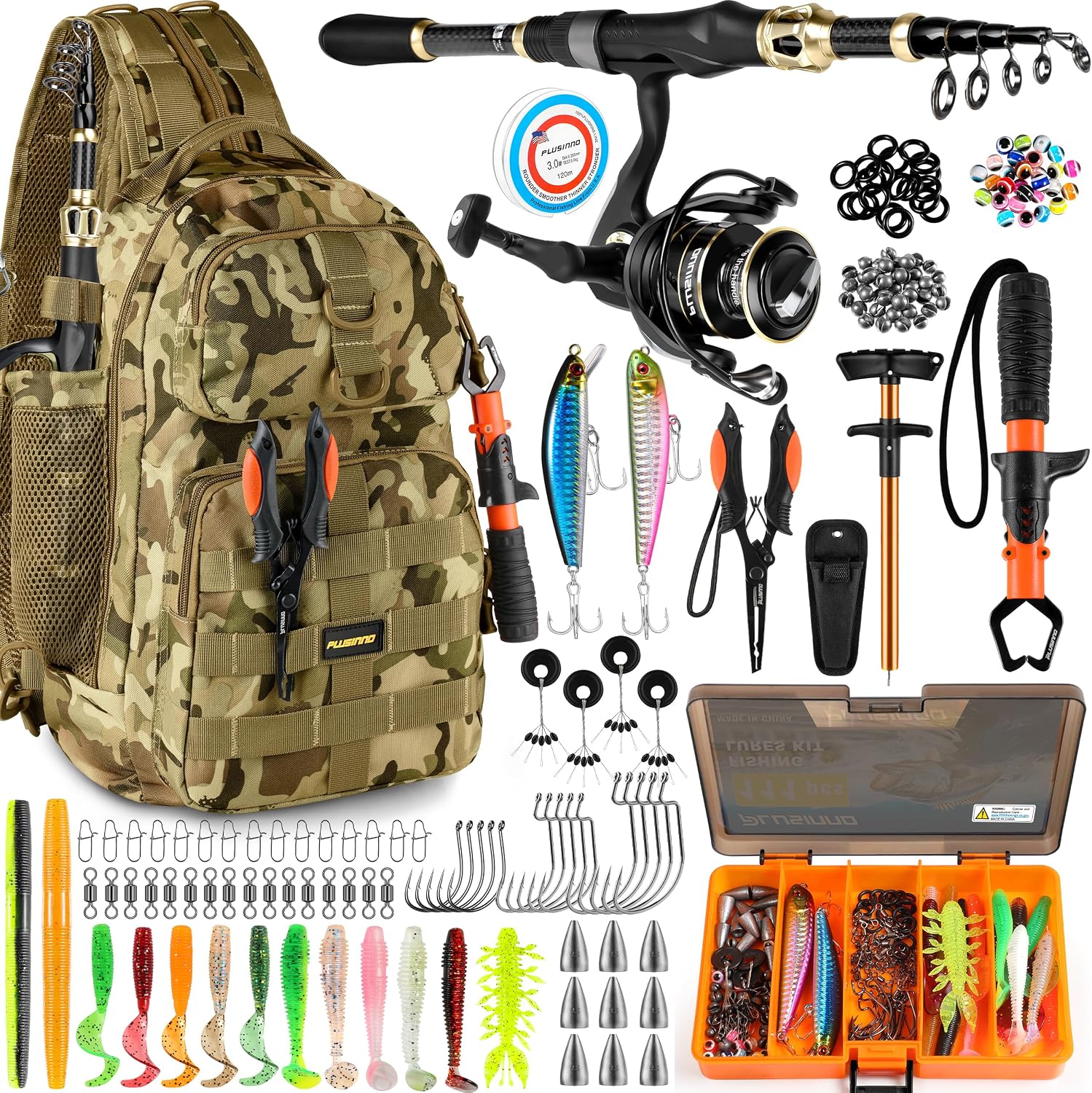
The kit: PLUSINNO Fishing Backpack with Rod & Reel Combos, Fishing Gear Kit
 Visit on Amazon →
This is the pack I recommend when someone wants one box that shows up with the rod, the reel, and a place to put everything else. Check current Amazon price.
The backpack is the part that matters most here, because it holds the rod tubes, the tackle boxes, the pliers, and the water bottle in one load you can carry down a bank or out on a pier. That organization is what separates a setup you use from a pile of gear in a garage. A second rod and reel in the kit also solves the problem I see most on family trips: one rod, two people, and a lot of standing around.
Where it fits: a first setup for a new angler, a spare rod for a guest or a kid, or a grab-and-go pack for short trips where you do not want to haul the full box.
Flaws but not dealbreakers: The reels that come in a combo kit are starter grade, and so is the factory line. Strip the line that ships on the spool and respool with fresh line before your first serious trip. That single change does more for casting distance than anything else you can do to a starter kit.
Anyone outfitting a beginner, a kid, or a second angler in the truck will get their money out of this pack.
The actual setup workflow
Do these in order. Skipping steps is how you end up with a rod that feels wrong on the water and gear you cannot find when a fish is on.
Step one: Pick the fish you actually catch. Write down the three species you fished most last year, not the one in the catalog photo. A rod matched to your real fish will outperform a better rod matched to a fish you see twice a season.
Step two: Match action to technique. Fast action for single hooks and light lures you cast a lot. Moderate action for treble hooks, crankbaits, and beginners who need the rod to absorb a head shake. If you cast all day, a moderate bend is easier on your arm.
Step three: Seat the reel and check the seat. Mount the reel, snug the hoods, then lock the drag and push the reel side to side. Any movement means the seat is not tight or the seat is bad. Fix it before you fish it.
Step four: Spool the line under tension. Run the line through the guides and onto the spool with tension on the filler spool, using a pencil or a screwdriver through the spool so it feeds straight. Fill the spool to within about an eighth of an inch of the lip. Overfilled spools throw loops off the front. Underfilled spools drag on the lip and cost you distance.
Step five: Check every guide. Cotton swab test on all of them, then look down the rod from the butt with light behind it. The guides should line up in a straight row. A bent guide is a casting problem and a line problem at the same time.
Step six: Set the drag by feel, then verify. Pull line off the spool by hand with the rod bent. It should come off smooth and steady, not jerky. If your reel has a drag scale, use it. If not, back the drag off after every trip so the washers are not compressed for months at a time.
Step seven: Load the pack by weight and access order. Heaviest items closest to your back. Tackle boxes where you can reach them without taking the pack off. Pliers and line clippers on the outside, because you will need those with a fish in your hand.
Step eight: Run a pre-trip check. Guides clean, line free of nicks for the first ten feet, drag set, knot retied, pack zipped. Five minutes at the truck saves a blown fish at the net.
Where this setup fails
Guides groove. It happens to every rod eventually, and it happens fastest to cheap rings and to rods that ride in a truck bed. Run the cotton swab test every few trips and replace a grooved guide before it shreds a spool of line.
Reel seats wobble. If you feel movement after a few months, retighten and check the hoods. If it still moves, the seat is the problem, and no amount of tape fixes a seat that will not hold.
Action ratings do not always match the bend. A rod labeled fast may fish more like a moderate. Trust how it loads on a real cast, not the label on the blank.
Saltwater ready is a marketing phrase. Rinse the rod and reel with fresh water after every salt trip, dry the guides, and back off the drag. Corrosion starts at the guide feet and the reel seat threads, and it starts quietly.
What this all costs
The rod and the pack are the two purchases, and you can check current Amazon price on both above. Beyond that, budget for fresh line, a handful of terminal tackle, and a spare spool of leader material. A spool of good line costs less than a tank of gas and it is the single biggest upgrade you can make to any rod you already own.
Over a full season, the math favors doing it once and doing it right. A rod that is set up correctly and rinsed after every trip lasts years, while a rod that is rigged in a hurry gets replaced every other season. The cost per trip drops fast when you stop buying replacements.
The setup is the job. The rod is a tool, the fish is the review, and the angler who spends two hours rigging in the driveway is the one still fishing in October.